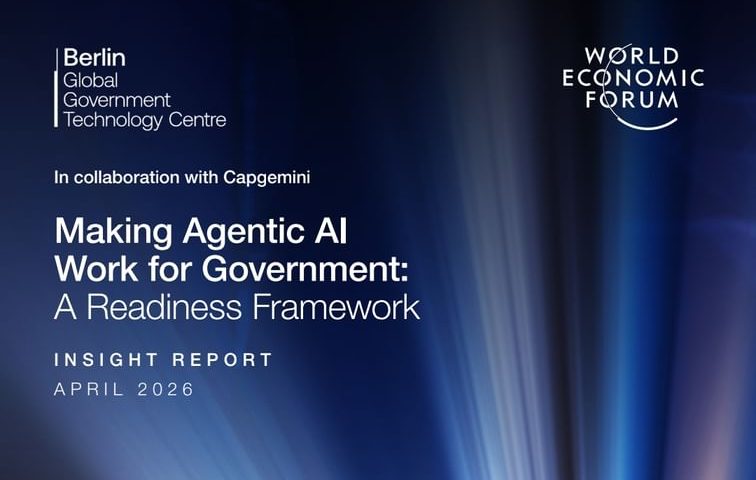
The United Arab Emirates has further strengthened its position as a global leader in government innovation after the World Economic Forum released a new report highlighting the UAE’s pioneering experience in deploying agentic artificial intelligence across government operations.
The report, titled “Making Agentic AI work for the Government: a Readiness Framework“, drew extensively on the UAE Government’s experience in integrating advanced technologies into public sector services, describing the country’s AI-powered Government Human Resources Assistant as a leading international model for the future development of government systems.
Minister of Cabinet Affairs, Mohammad Abdullah Al Gergawi, said the UAE, guided by its leadership’s forward-looking vision, has established an advanced government model that has evolved into an inspiring global success story for governments seeking to shape the future of humanity through innovation-driven governance.
Al Gergawi stated that the UAE’s continuous adoption of artificial intelligence applications across government sectors and services has reinforced the country’s international leadership in anticipating and shaping the future of government work. He added that every new achievement reflects a strategic approach that places AI at the core of development and positive transformation, ultimately serving society and enhancing quality of life.
He described the World Economic Forum report as a new international endorsement of the advanced level reached by the UAE Government, noting that the country is moving forward with plans to transform 50 per cent of its sectors, services and operational processes into self-executing AI-based models within the next two years.
According to Al Gergawi, the initiative supports the UAE’s broader efforts to develop a future-ready government model while strengthening the country’s position as a global hub for innovation through expanded AI applications that improve public services, support the national economy and enhance quality of life.
The report was launched by the World Economic Forum in cooperation with the Global Government Technology Centre and Capgemini during an international dialogue on the adoption of agentic AI in government. The event brought together global experts and decision-makers, including Mohammad Bin Taliah, Timo Graf von Königsmarck, Valeriya Ionan, Manuel Killian and Marc Reinhardt.
The discussion explored how governments can maximise the value of agentic AI while strengthening governance frameworks to ensure transparency, trust and resilience. It also reviewed the UAE’s strategy to expand AI adoption across government operations over the coming two years.
The report highlighted four major international case studies in the use of agentic AI, including the UAE’s Government Human Resources Assistant alongside similar initiatives in Germany and Ukraine.
According to the report, the UAE’s Federal Authority for Government Human Resources launched the AI assistant as part of an ambitious strategy to integrate artificial intelligence into government processes and simplify procedures.
The assistant provides an interactive interface supporting more than 130 digital services while automating a broad range of employee self-service transactions. Its initial phase focused on the most common procedural and legal human resources enquiries.
The report noted that the Human Resources Assistant successfully resolved more than 80 per cent of HR legislation and policy enquiries automatically, accelerating response times, improving accuracy and delivering seamless services to more than 50,000 employees. It has also contributed to re-engineering workflows and reducing human intervention, allowing specialists to focus on higher-value strategic tasks.
The report described agentic AI as a transformative shift that extends beyond traditional task automation towards building integrated systems capable of planning, coordinating and executing complex multi-step operations. It stated that governments seeking to improve services, enhance efficiency and strengthen responsiveness now have an unprecedented opportunity to redesign operational models and achieve more effective outcomes.
To support governments in adopting these technologies responsibly, the report introduced a practical readiness framework that evaluates 70 core government functions according to two main criteria: agentic AI potential and implementation complexity. Tasks are classified into high, medium and low readiness levels, enabling governments to prioritise deployment more effectively.
The report found that around 50 per cent of the government tasks assessed combined relatively high AI potential with manageable implementation complexity, indicating that large-scale adoption within suitable institutional environments is increasingly achievable. Among the areas identified as most ready for deployment were cybersecurity monitoring, public information services and system performance monitoring.
It also stressed the importance of initially focusing on government functions capable of delivering clear public value while maintaining manageable risk levels, arguing that early successful deployments can strengthen institutional trust and organisational capabilities.
The report emphasised that successful implementation depends not only on technological readiness but also on robust governance, accountability, transparency, legal clarity, data quality, organisational preparedness and effective human oversight. It underscored that the development and adoption of agentic AI should ultimately be driven by its ability to improve outcomes, accelerate services and enhance administrative efficiency while adhering to ethical governance standards.
Concluding its findings, the report described agentic AI as a strategic capability for governments rather than merely a technological tool. It recommended a gradual, evidence-based approach to adoption beginning with high-readiness functions and using early implementations to test governance frameworks in practice.
The report also cited a global survey conducted by Capgemini involving 350 government institutions worldwide, which found that 90 per cent of organisations plan to explore or implement agentic AI within the next two to three years.
It concluded that governments adopting agentic AI through disciplined planning and strategic governance will not only improve their operational performance, but also shape global standards and expectations for how advanced AI technologies can serve the public interest.