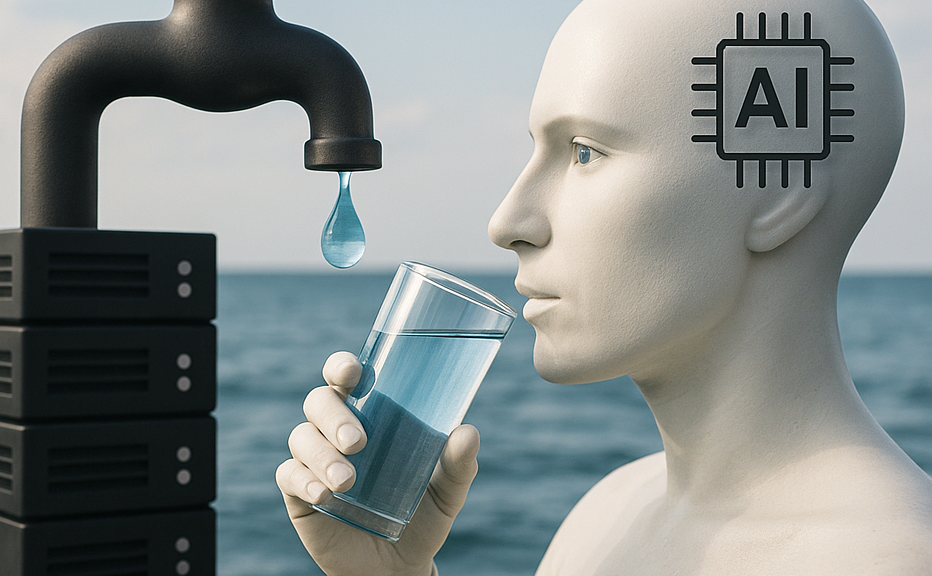
Protests have recently been held in several US states, from Texas and New Mexico to Arizona, against the expansion of data centre construction. Demonstrators carried signs reading “Water for people, not AI”, “Don’t mess with our water” and “Save water”, objecting to the large quantities of water consumed by these facilities, which form the backbone of AI systems worldwide, as well as their environmental impact and high energy consumption.
While there is little doubt about the vast amounts of energy consumed by data centres, the scale of their water consumption remains a more complex issue. There is no clear official data on the amount of water used by these facilities to cool their servers, while reports and articles have suggested that AI systems consume around 500 millilitres of water for each online search.
Experts stress that data centre water consumption remains relatively small compared with that of other economic sectors, particularly agriculture and certain industries. However, specialists estimate that data centre cooling systems consumed around 66 billion litres of water in 2023, equivalent to nearly one per cent of total water consumption in the United States.
AI experts say a range of measures can be adopted to reduce the pressure placed on local water resources around AI data centres.
Fengqi You, an energy systems expert at Cornell University, said there are “many good ideas” for addressing the issue. He added that it could be possible to achieve zero water consumption for cooling AI systems if greater efforts were made to develop and preserve natural water resources.
Shaolei Ren, a specialist in electrical and computer engineering at the University of California, Riverside, said recent advances in AI technologies had helped reduce the amount of water required by many data centres. He noted that older versions of ChatGPT, for example, consumed around 500 millilitres of water to generate a draft email in 2024, whereas Google said in 2025 that an average-length search on its AI application Gemini required no more than five drops of water.
However, You noted that even this small amount of water could become a significant problem given the rapid expansion of AI use worldwide. A recent study conducted by You’s research group found that by 2030, US data centres could consume between 731 billion and 1.125 trillion litres of water annually, roughly equivalent to the amount of drinking water consumed by New York City each year.
Josh Parker, Sustainability Director at AI chipmaker NVIDIA, said technological advances had played a major role in reducing reliance on water-based cooling systems. He added that newer generations of processors can operate at temperatures of up to 113 degrees Fahrenheit, significantly higher than the temperatures traditionally tolerated by earlier hardware.
Advances in cooling technologies are expected to be a key factor in helping technology companies meet the sustainability targets they have set for their operations.
US technology giant Amazon said in a statement that it aims to achieve “water positive” operations by 2030. This means returning more water to communities than its direct operations consume. The company said it had already completed half of the journey towards that goal by 2024.