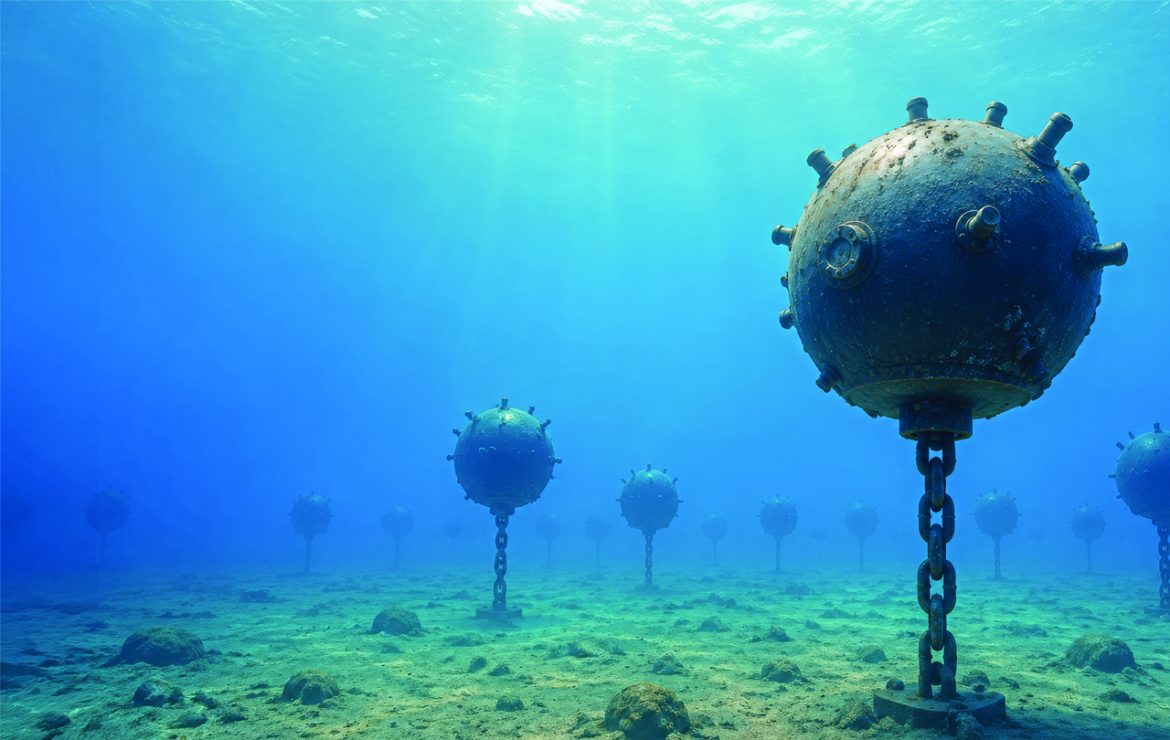
Naval mines have long been among the most influential weapons in maritime warfare, repeatedly altering the course of naval campaigns by inflicting severe damage on individual warships and, in many cases, restricting the movement of entire fleets. Despite their relatively simple design and comparatively low cost, mines have consistently demonstrated a disproportionate strategic impact, enabling even weaker naval powers to challenge technologically superior adversaries and deny them freedom of manoeuvre in contested waters. The legacy of naval mining continues to shape today’s maritime environment. Thousands of mines laid during previous conflicts remain concealed beneath the sea, contributing to an estimated 1.6 million tonnes of unexploded ordnance scattered across waters around the world. At the same time, more than fifty countries continue to maintain naval mine inventories numbering in the millions, reflecting the enduring military value attached to these weapons.
Although naval mines appeared to lose strategic prominence following the Second World War, their renewed employment in contemporary conflicts—most notably the Russia–Ukraine War and the recent confrontation involving Iran—has revived debate over their role in modern maritime operations. These developments raise an important question: do naval mines remain a decisive instrument in twenty-first-century naval warfare, or have advances in surveillance, precision strike capabilities, and mine countermeasure technologies diminished their operational significance?
The Evolution of Naval Mines and Their Different Types
Despite their outward simplicity, naval mines rank among the most sophisticated weapons employed at sea. Their apparent simplicity stems from their relatively limited number of mechanical components, while their true complexity lies in the intelligent sensing and activation systems integrated into modern designs. A typical naval mine consists of a deployment mechanism, an explosive casing, an arming device with a detonating chain, a power source, and a target detection system. It is this detection mechanism that distinguishes a naval mine from a conventional bomb, allowing it to monitor its underwater environment continuously and detonate only when specific operational conditions are met. Military literature commonly defines a naval mine as a self-contained explosive device placed in water to destroy submarines or surface vessels, or to deny an adversary access to designated maritime areas. Their origins are generally traced to the American Revolutionary War, when David Bushnell introduced one of the earliest mine concepts in 1777. His design, intended to target elements of the British fleet in the Delaware River near Philadelphia, consisted of a floating gunpowder barrel equipped with a mechanical firing mechanism that detonated upon impact. Although the device failed to inflict significant damage, it attracted considerable military interest and laid the foundations for the subsequent development of naval mine warfare. Naval mines assumed a far greater role during the American Civil War, when the Confederate Navy relied extensively on them to counter the Union’s superior naval forces. Their strategic importance expanded further during the First World War, particularly through Allied efforts to contain German submarine operations in the North Sea. In 1918, Britain and the United States established the North Sea Mine Barrage, stretching approximately 250 miles between Scotland and Norway. Comprising around 72,000 mines, the barrier succeeded in sinking several German submarines while severely disrupting enemy naval operations. The Second World War demonstrated the full economic and military potential of naval mining. The United States deployed more than 12,000 mines along Japanese shipping routes and harbour entrances, ultimately sinking approximately 650 Japanese vessels and severely disrupting Japan’s maritime logistics network. During the conflict, naval mines became one of the most effective tools for economic warfare by denying access to ports, restricting commercial shipping, and imposing substantial costs on naval operations. Historical estimates indicate that more than 1,000 military and merchant vessels were lost to naval mines during the First World War, while approximately 2,665 ships were either sunk or damaged by mines during the Second World War. Contrary to post-war expectations that advances in naval technology would render mines obsolete, subsequent conflicts demonstrated their continued effectiveness. During the Korean War, the Soviet Union supplied North Korea with thousands of naval mines to defend key ports, resulting in damage to several American warships. Likewise, during the Vietnam War, the United States employed more than 300,000 naval mines. In 1972 alone, approximately 11,000 mines were laid in Haiphong Harbour, effectively sealing the port for several months and severely restricting North Vietnamese maritime logistics.
Principal Types of Naval Mines
Although naval mines exist in numerous configurations, they generally fall into four principal categories. Floating mines drift freely on or near the water’s surface and normally detonate upon physical contact with a vessel. Their unpredictable movement makes them inherently indiscriminate, leading to their prohibition under the 1907 Hague Convention except under highly restricted circumstances. Moored mines remain suspended below the water’s surface by means of an anchor fixed to the seabed. Often recognised by their distinctive spherical shape fitted with contact horns, these mines became widely associated with the First World War. Their design allows deployment in relatively deep waters, making them effective against both surface ships and submarines. Bottom or influence mines rest directly on the seabed, usually in shallow or medium-depth waters, although some advanced models can operate at greater depths. Rather than requiring physical contact, these mines detect vessels by monitoring changes in magnetic fields, acoustic signatures, or water pressure. A notable example is the Italian-designed Manta mine, employed by Iraq during the 1991 Gulf War. Controlled mines are connected by cable to a shore-based control station, allowing operators to decide whether to detonate the mine when an approaching vessel has been positively identified. The United States employed such systems extensively during the early twentieth century to defend major harbours and coastal installations, where selective engagement reduced the risk of accidental detonation against friendly shipping.
Modern Mine Deployment and Triggering Mechanisms
Naval mine deployment methods have evolved alongside advances in naval warfare. Initially, mines were laid almost exclusively by surface vessels. During the First World War, submarines emerged as an effective means of covert deployment, while the Second World War witnessed the widespread use of aircraft to seed extensive minefields rapidly over large maritime areas. Today, mines can also be deployed by fast attack craft, patrol boats, submarines, helicopters, and fixed-wing aircraft, significantly expanding the operational flexibility of mine warfare.
Detonation methods have undergone an equally significant transformation. Traditional contact mines explode only after colliding with a vessel, whereas influence mines employ sophisticated sensors capable of detecting magnetic disturbances, acoustic signatures, pressure changes, or combinations of these indicators. Controlled mines, meanwhile, are activated remotely by coastal operators after visual or electronic confirmation of a target. The latest generation of naval mines incorporates multiple sensing technologies within a single system, allowing them to discriminate between different classes of vessels. Some are programmed to ignore smaller craft or mine countermeasure operations, detonating only after a predetermined number of ships have passed in order to maximise their effectiveness against high-value naval targets. Iran’s Maham-3 mine, for example, reportedly combines magnetic and acoustic sensors to enhance target discrimination. Modern mine design has also evolved considerably. Many contemporary mines adopt cylindrical or torpedo-shaped configurations that facilitate deployment from submarines or aircraft before descending in a controlled manner to the seabed. More advanced systems, known as rising mines, remain dormant on the seabed until they detect a target, whereupon they launch upward to intercept and destroy the approaching vessel. Such innovations illustrate how naval mines have evolved from simple contact explosives into sophisticated, intelligent underwater weapons capable of posing a serious challenge even to advanced naval forces.
 Why Do States Resort to Naval Mine Warfare, and Is Their Use Lawful?
Naval mines remain one of the most effective tools for offsetting an opponent’s numerical or technological superiority at sea. Rather than seeking decisive fleet engagements, states employ mine warfare to deny access to critical maritime areas, inflict attrition on enemy naval forces, and impose significant operational delays. Even the mere possibility of mines being present can compel an adversary to divert considerable resources towards mine countermeasure operations before advancing, thereby slowing military campaigns and disrupting operational planning. Beyond damaging surface combatants, naval mines can be used to bottle up hostile submarines within their home ports, deny access to strategically important sea lanes, or restrict navigation through key maritime chokepoints until political or military conditions are met. This combination of deterrence, area denial, and economic disruption explains why mine warfare has remained a recurring feature of naval conflicts despite rapid advances in maritime technology.
Throughout the past century, naval mines have evolved from rudimentary underwater explosives into sophisticated underwater weapons capable of influencing strategic decision-making. During the 1980s, for example, Iran employed naval mines to disrupt commercial shipping and military navigation in the Arabian Gulf, culminating in the mining of the U.S. Navy guided-missile frigate USS Samuel B. Roberts (FFG-58). Similarly, during Operation Desert Storm (1990–1991), Iraqi minefields prevented the U.S. Navy’s Amphibious Task Force from conducting planned operations off the Kuwaiti coast, exposing coalition forces to greater operational risks while severely damaging the guided-missile cruiser USS Princeton (CG-59) and the amphibious assault ship USS Tripoli (LPH-10). These incidents demonstrated that relatively inexpensive naval mines could constrain the manoeuvre of some of the world’s most advanced naval forces.
The Legal Framework Governing Naval Mine Warfare
The principal international legal instrument regulating the use of naval mines remains the 1907 Hague Convention VIII, formally adopted following the extensive civilian and neutral shipping losses caused by naval mines during the Russo–Japanese War (1904–1905). The Convention sought to establish rules governing the deployment of mines while safeguarding neutral commerce and freedom of navigation. Among its principal provisions, the Convention prohibits the deployment of naval mines that cannot distinguish between legitimate military targets and civilian or neutral vessels. It also requires drifting mines to become harmless within one hour if control over them is lost, while moored mines must automatically deactivate should they break free from their anchors. Furthermore, the Convention prohibits laying mines solely to attack commercial shipping and obliges belligerent states to consider the safety of peaceful navigation. Where operational circumstances permit, parties are also expected to notify others of mined areas to minimise risks to neutral maritime traffic. In addition to the Hague Convention, customary international law imposes broader legal constraints on the use of naval mines through fundamental principles such as distinction, proportionality, and the right of innocent passage. Nevertheless, significant legal ambiguities remain. Unlike anti-personnel landmines, which are regulated by dedicated international treaties, no comprehensive convention prohibits the possession or use of naval mines. Moreover, international law still lacks a universally accepted legal definition of what constitutes a naval mine, leaving considerable scope for differing interpretations regarding their lawful employment.
The Growing International Focus on Naval Mine Threats
Although naval mines have long represented one of the most cost-effective instruments of maritime warfare, concern over their strategic significance has intensified in recent years as their proliferation has expanded. Today, more than fifty countries possess naval mine capabilities, while at least thirty have demonstrated indigenous production capacity. At the same time, certain non-state actors have also turned to these relatively inexpensive weapons to threaten commercial shipping and disrupt maritime trade.
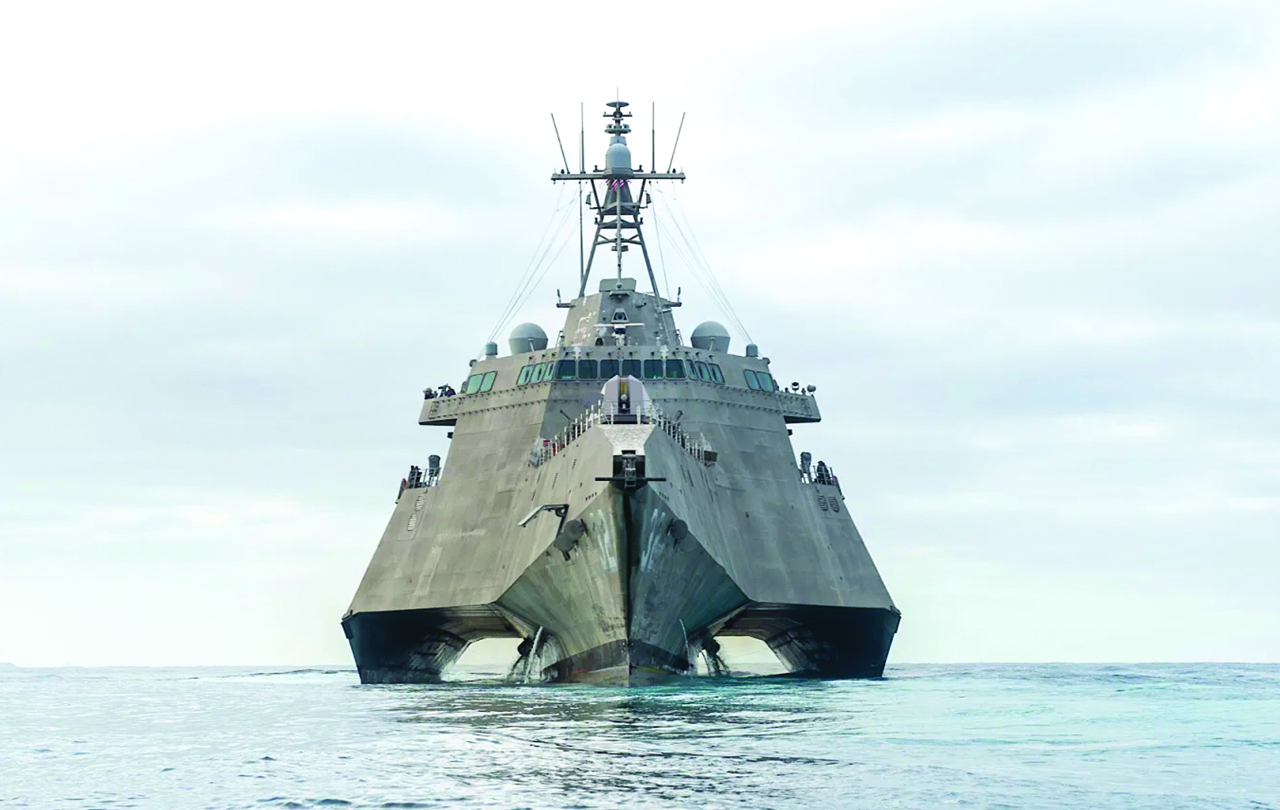
Western assessments indicate that China possesses an inventory of approximately 100,000 mines, including a substantial number of advanced naval mines. Such capabilities could enable Beijing to establish extensive maritime denial zones across strategically important waterways, including the island chains separating East Asia from the broader Pacific, the South China Sea, and potentially other critical maritime approaches in the event of a future conflict with the United States or a military operation against Taiwan. At the same time, several American defence assessments have warned that the U.S. Navy’s mine countermeasure capabilities have declined as key dedicated platforms have been retired. The MH-53E Airborne Mine Countermeasures (AMCM) helicopters were withdrawn from service in August 2025, while the final four Avenger-class mine countermeasure vessels were decommissioned shortly afterwards. As a result, much of the Navy’s remaining capability now depends on a limited number of Littoral Combat Ships (LCS), which require continued integration of advanced mine countermeasure packages, particularly unmanned systems capable of detecting and neutralising mines remotely.
While the United States and several NATO members have reduced portions of their dedicated mine warfare fleets, many of Washington’s strategic competitors have moved in the opposite direction. Russia has continued expanding its specialised mine countermeasure force through the introduction of additional Alexander Obukhov (Project 12700 Alexandrit-class) minehunters, complementing existing Natya-class vessels. China has likewise strengthened its capabilities by introducing new generations of dedicated mine countermeasure ships, reflecting a broader recognition that naval mines—and the ability to defeat them—remain central components of modern maritime strategy.
Mine Countermeasures: Neutralising Underwater Threats
The challenge posed by naval mines has driven the continuous evolution of mine countermeasure operations, encompassing a broad range of technologies and tactics designed to detect, identify, and eliminate underwater explosives before they threaten naval or commercial shipping.
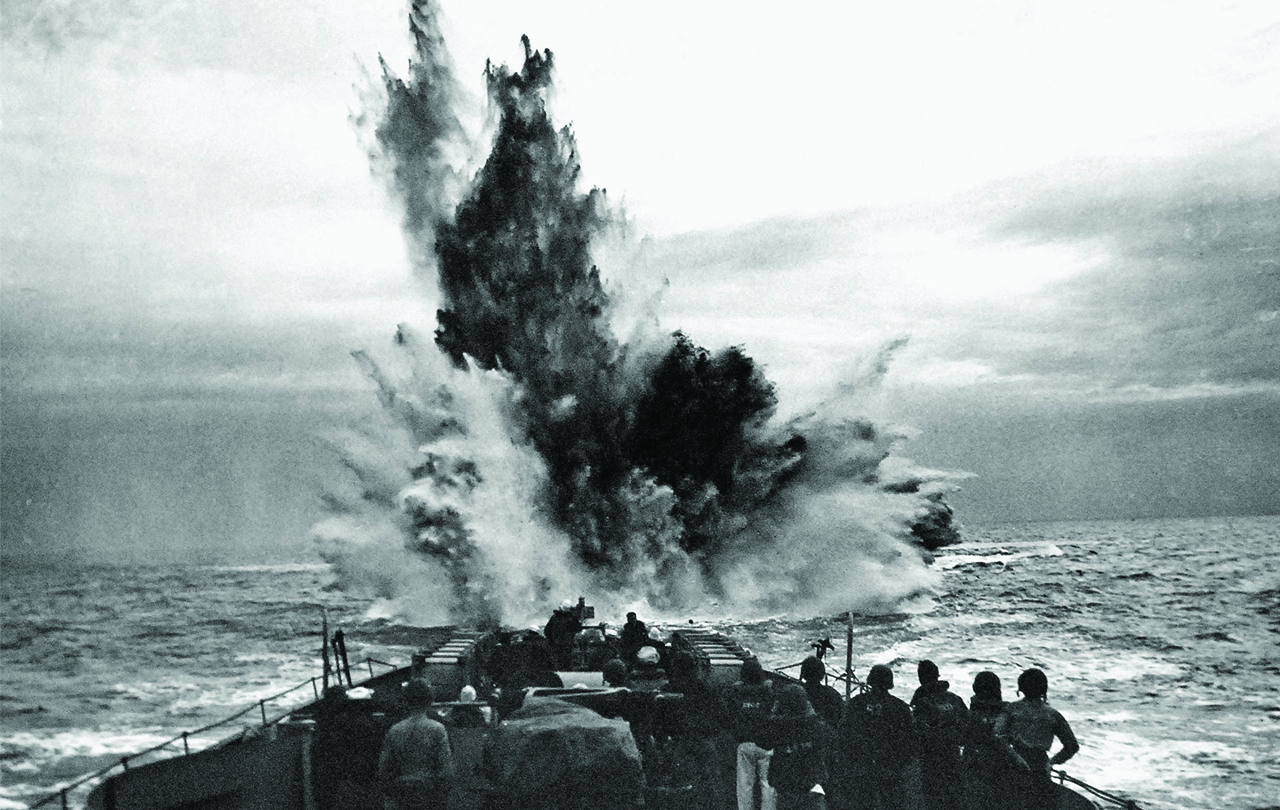
Traditional mine clearance methods relied on specialised minesweepers towing cables between two vessels to sever the mooring wires of anchored mines, allowing them to float to the surface where they could be destroyed by naval gunfire. Although simple in concept, this method remains effective against conventional moored mines.
Technological innovation has significantly expanded these capabilities. Modern mine countermeasure forces increasingly employ unmanned underwater and surface vehicles, advanced sonar systems, remotely operated vehicles, and precision underwater demolition systems capable of locating and destroying mines without placing personnel directly at risk. Airborne mine countermeasures have also played an important role. During the Second World War, modified Vickers Wellington aircraft equipped with large electromagnetic coils generated powerful magnetic fields while flying at low altitude, triggering magnetic influence mines from a safe distance. Similar principles later inspired electromagnetic sweeping systems installed aboard converted commercial vessels, enabling them to generate magnetic pulses capable of detonating submerged mines.
Certain situations, however, still require direct intervention. Once a mine has been located and positively identified, specially trained naval divers may be deployed to attach explosive charges and neutralise it manually, particularly in confined waters where other methods prove unsuitable. Despite these advances, mine clearance remains one of the most demanding and resource-intensive tasks in naval warfare. Clearing even relatively small suspected minefields can require months—or even years—of painstaking operations. Following the 1991 Gulf War, for instance, Australia’s contribution to mine clearance operations in Kuwaiti waters lasted approximately five months. During that period, forces searched an area of only around two square kilometres yet recovered and neutralised approximately sixty naval mines, illustrating the considerable time, cost, and technical expertise required to eliminate underwater mine threats safely.
Naval Mine Warfare in Modern Conflicts: The Cases of Iran and Ukraine
The renewed prominence of naval mines has been illustrated most clearly by two recent conflicts: the confrontation involving Iran in the Arabian Gulf and the ongoing Russia–Ukraine War in the Black Sea. In both cases, naval mines demonstrated that relatively inexpensive underwater weapons can generate strategic effects extending far beyond the immediate battlefield, threatening global trade, energy security, and freedom of navigation. Following the outbreak of the U.S.–Israeli military campaign against Iran earlier this year, Tehran announced the near-complete closure of the Strait of Hormuz while signalling the possible deployment of naval mines within the strategic waterway. The announcement immediately raised international concerns. Before the conflict, approximately one-fifth of the world’s seaborne oil and liquefied natural gas (LNG) exports transited the Strait of Hormuz. Consequently, even the suspected presence of a single naval mine can be sufficient to disrupt commercial shipping, increase insurance premiums, and generate significant volatility in global energy markets. Iran is widely believed to possess an arsenal of approximately 5,000–6,000 naval mines, many of which are produced domestically, while others are reportedly acquired from China and Russia. The uncertainty surrounding Tehran’s actions further complicated the situation. Iranian authorities neither confirmed nor denied the actual deployment of mines, instead maintaining deliberate ambiguity regarding their possible presence. This uncertainty itself became a strategic instrument, forcing commercial operators and naval planners to assume the worst-case scenario. According to several European assessments, approximately eighty naval mines may have been deployed within the Strait, primarily advanced Maham-3 and Maham-7 influence mines. These reports suggested the existence of four separate minefields positioned near the western entrance to the Strait, the eastbound and westbound shipping channels, and the eastern exit towards the Gulf of Oman. Whether or not these estimates prove entirely accurate, the episode demonstrated how uncertainty surrounding mine warfare can produce strategic consequences comparable to the physical presence of the mines themselves.
The crisis also exposed shortcomings in American mine countermeasure capabilities. Previous assumptions within parts of the U.S. Navy that large-scale mine warfare had become a secondary concern were challenged by the operational realities of the Hormuz crisis, particularly as the Navy continues to modernise the Mine Countermeasures (MCM) mission packages assigned to its Littoral Combat Ships. Consequently, Washington has increasingly looked towards NATO allies to shoulder a larger share of future multinational mine clearance operations. Western defence analyses further suggest that clearing the Strait of Hormuz would represent a highly complex undertaking requiring extensive international coordination. Although commercial shipping began to recover following the U.S.–Iran memorandum of understanding, restoring unrestricted navigation would still depend upon verifying and eliminating any remaining mine threats. While the agreement reportedly assigned Iran responsibility for clearing the Strait, Tehran is generally considered unlikely to possess sufficient mine countermeasure capabilities to conduct such operations independently. This has created opportunities for broader multinational cooperation, with countries including the United Kingdom and France expressing willingness to contribute specialist mine clearance assets if required. A different but equally instructive example has emerged from the Russia–Ukraine War, where both sides have employed naval mines extensively throughout the Black Sea. Western intelligence assessments indicate that Russia deployed hundreds of naval mines following the outbreak of hostilities in 2022. Ukraine likewise acknowledged in June of that year that it had laid defensive minefields to impede Russian amphibious operations and protect its coastline.
Since then, Moscow and Kyiv have repeatedly accused one another of deploying additional mines, creating considerable uncertainty regarding the actual scale and distribution of the threat. Ukrainian estimates have claimed that Russia placed between 400 and 600 mines within Ukrainian territorial waters, while Russian sources have alleged that approximately 370 drifting mines deployed by Ukraine were operating off the coast of Odesa.
 The Future of Naval Mines in Modern Maritime Warfare
The modern naval mine bears little resemblance to the traditional spiked contact mine that has become synonymous with naval warfare, although such legacy systems continue to exist. Contemporary mines have evolved into intelligent underwater weapons capable of generating effects far beyond simple explosive destruction. Increasingly sophisticated “smart” mines can combine multiple sensors, collect environmental data, discriminate between different classes of vessels, and activate only under carefully programmed conditions. Some systems can remain dormant for extended periods before reconfiguring their operating parameters or responding to changing tactical circumstances, allowing states to establish persistent maritime denial zones long before hostilities begin. The rapid expansion of autonomous and unmanned maritime systems has further renewed international interest in both offensive mine warfare and mine countermeasure operations. Navies capable of developing integrated, affordable mine warfare solutions are likely to gain significant strategic advantages by enhancing operational freedom of manoeuvre while simultaneously restricting that of their adversaries. Consequently, naval mines are no longer viewed solely as independent weapons but increasingly as integral components of broader joint military operations. Modern minefields can support submarine campaigns, surface fleet operations, air power, and even land-based military strategies as part of a comprehensive anti-access and area-denial (A2/AD) architecture. Reflecting this evolution, several countries are developing entirely new deployment methods. China, for example, has introduced EM-52/T-1 rocket-delivered naval mines capable of remote activation, expanding both their operational reach and tactical flexibility.
Unmanned underwater vehicles are also transforming offensive mine warfare. Rather than relying exclusively on submarines or surface vessels, autonomous underwater platforms can covertly deploy mines in contested waters while reducing risks to personnel. Ukraine’s Sea Baby unmanned maritime system has demonstrated the growing potential of autonomous platforms to deliver offensive payloads—including naval mines—against Russian naval targets.
At the same time, advances in mine countermeasure technology are progressing at an equally rapid pace. Many navies are investing heavily in autonomous underwater vehicles, artificial intelligence, high-resolution sonar systems, and remotely operated platforms capable of surveying larger maritime areas at unprecedented speed. These technologies enable operators not only to detect suspicious underwater objects more efficiently but also to classify and neutralise them with greater precision while minimising risks to human personnel. Many Western defence studies therefore conclude that offensive mine warfare is likely to play an increasingly prominent role in future maritime conflicts. Tomorrow’s naval mines are expected to combine the durability and wide-area coverage of traditional mines with the manoeuvrability of torpedoes and the autonomy of unmanned underwater vehicles. This convergence of technologies has the potential to create highly adaptive underwater weapons capable of fundamentally reshaping the maritime battlespace.
Conclusion
Although naval mines are often perceived as relics of twentieth-century warfare, recent conflicts have demonstrated that they remain among the most effective and strategically influential weapons available to modern navies. Their widespread availability, relatively low production costs, ease of deployment, and ability to disrupt maritime operations continue to make them indispensable instruments of sea denial.
The strategic value of naval mines lies not merely in the ships they destroy but in the uncertainty they create. Modern mines can delay military offensives, compel adversaries to commit substantial resources to lengthy clearance operations, disrupt global trade, threaten critical energy supply routes, and even influence diplomatic negotiations. A weapon costing only tens of thousands of dollars can impose economic and strategic costs worth billions, forcing technologically superior opponents to alter operational plans—or abandon them altogether.●
By: Adnan Moussa (Assistant Lecturer, Faculty of Economics and Political Science, Cairo University)