The main battle tank is no longer simply an armoured platform equipped with a main gun and designed for direct engagements with enemy targets. The proliferation of drones, loitering munitions, anti-armour weapons and top-attack threats, combined with rapid advances in sensors and digital networks, is imposing new requirements on tanks that extend far beyond traditional firepower, protection and mobility.
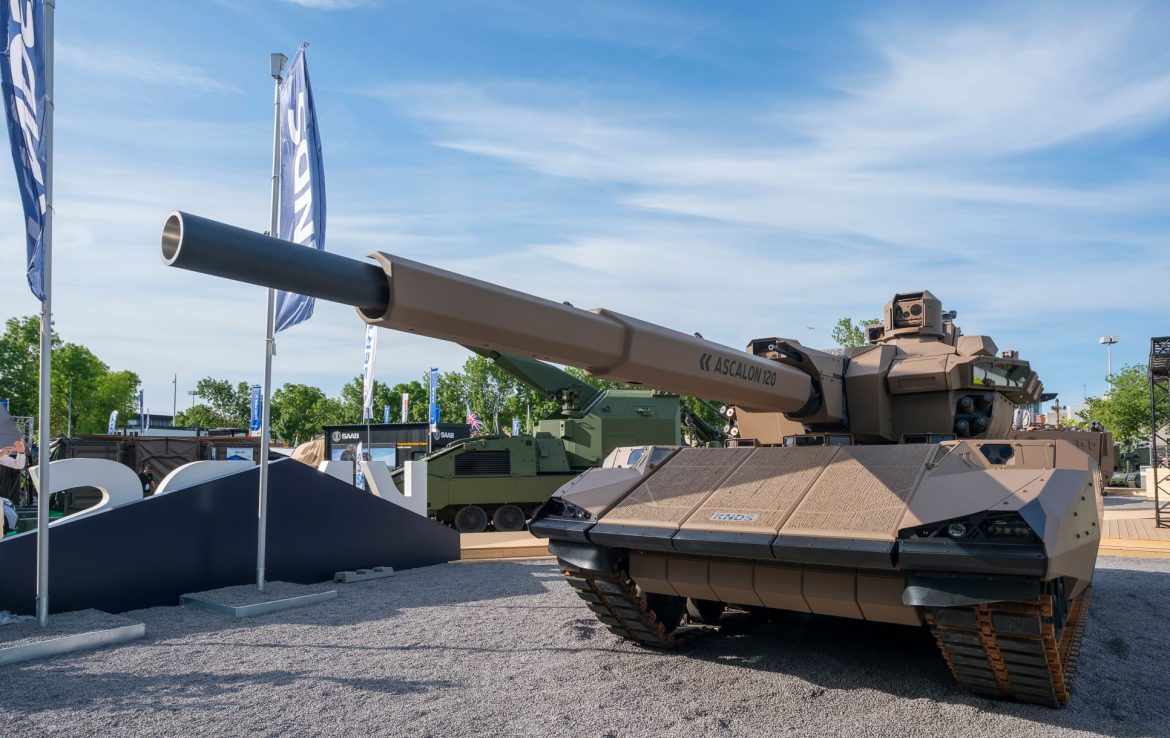
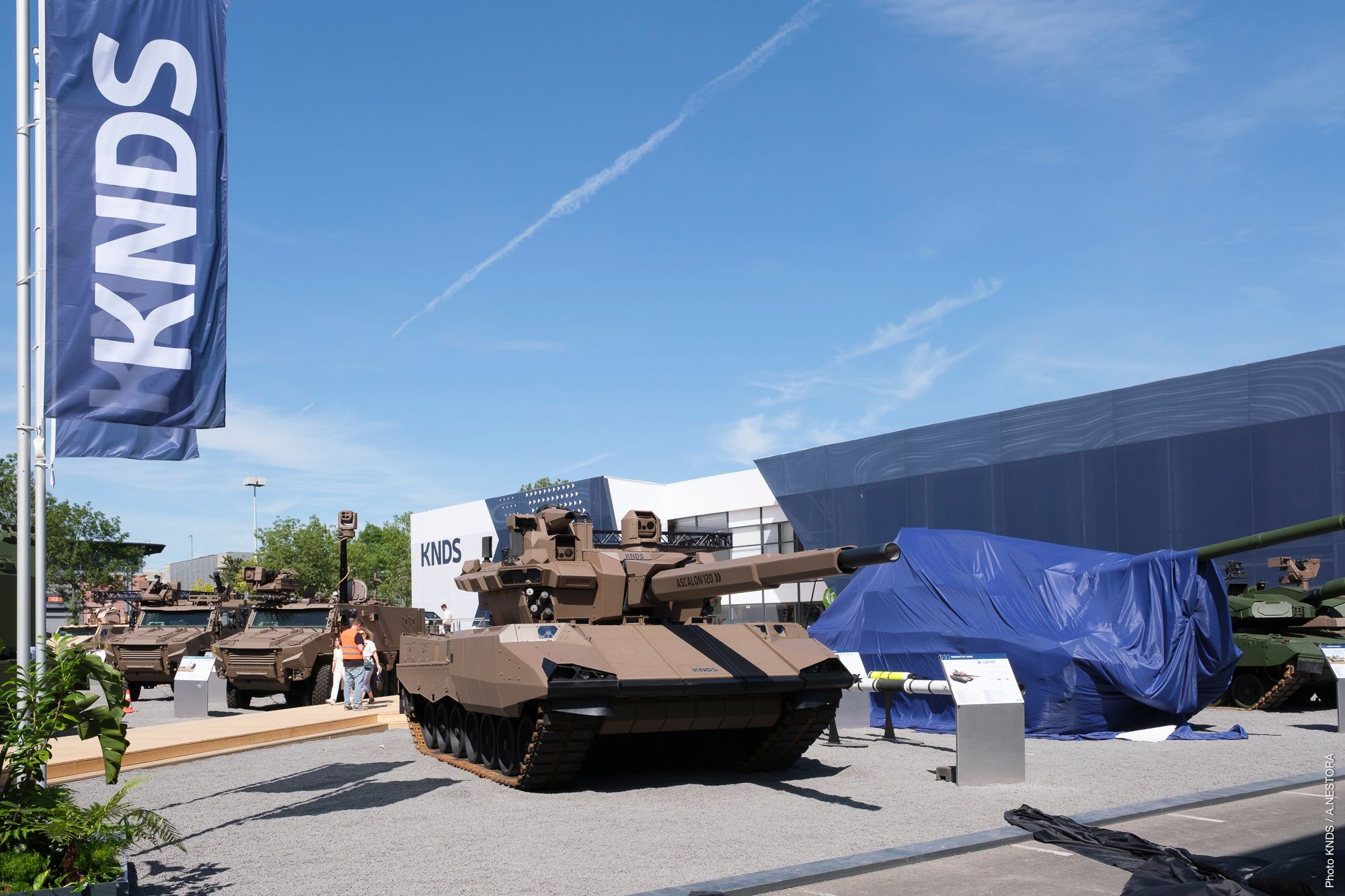
Against this backdrop, KNDS unveiled its CAPINT MBT concept at Eurosatory 2026. The French-led proposal combines a further-developed Leopard 2-derived chassis, an Ascalon unmanned turret, an autoloaded main gun, an open digital architecture, counter-UAV capabilities, and the ability to connect with unmanned robotic platforms and systems.
Rather than representing a conventional tank design, the CAPINT MBT is conceived by KNDS as a multi-platform system centred on a main platform with both direct combat and broader networked capabilities, and supported by robotic “wingmen”. This approach is intended to expand the platform’s capabilities and enable it to adapt to the changing requirements of the battlefield.
KNDS: French and German Expertise Behind a Single Platform
CAPINT is being developed by KNDS, the European land-systems group established in December 2015 through the combination of France’s Nexter and Germany’s Krauss-Maffei Wegmann. The group brings together French and German expertise spanning some of Europe’s most prominent tank programmes, including the Leclerc and Leopard 2.
KNDS operates across a broad range of land warfare capabilities, including tanks, armoured vehicles, artillery, ammunition, command-and-control systems and robotic solutions. Its expertise enables the integration of different elements of the land combat system, from firepower, protection and mobility to digitalisation and counter-drone capabilities.
KNDS France’s tank expertise is rooted in the Leclerc programme, whose deliveries were completed in 2007. Existing Leclerc tanks are now being upgraded to the Leclerc XLR standard, providing enhanced capabilities pending the transition to the next generation of combat systems.
This background is particularly significant in the development of the CAPINT MBT. The platform combines a three-person Leopard 2 variant chassis developed by KNDS Deutschland with the Ascalon unmanned turret developed by KNDS France, bringing French and German expertise together in a single combat platform.
CAPINT is therefore not an isolated project within KNDS’ tank development roadmap. Instead, it forms part of a broader progression encompassing the Leopard 2 A8 and Leclerc XLR, as well as intermediate concepts such as the Leopard 2 A-RC 3.0 and Leclerc Evolution, leading towards technologies associated with the future Main Ground Combat System (MGCS).
CAPINT MBT: An Intermediate Capability Between Present and Future
The name CAPINT refers to CAPacité INTermédiaire, meaning “Intermediate Capability”, reflecting the project’s position between today’s main battle tanks and the future MGCS. KNDS is targeting the introduction of the first units during the 2030s.
The concept goes beyond upgrading an existing tank. Instead, it seeks to provide a platform capable of evolving alongside battlefield requirements, particularly as drone threats increase and ground warfare becomes increasingly dependent on networked and autonomous systems.
The CAPINT MBT is designed around a new-generation, highly resilient, modular and open digital architecture, allowing it to connect with supporting unmanned platforms and incorporate new capabilities as they emerge.
Leopard 2 Variant Chassis: A Mature Foundation for a New System
The CAPINT MBT is based on a developed three-person Leopard 2 variant chassis. It is powered by a 1,100-kilowatt powerpack, equivalent to approximately 1,500 horsepower.
According to the vehicle’s display specifications, the CAPINT MBT has a road speed of approximately 65 km/h and a road range of more than 450 kilometres, while ground clearance stands at 500 millimetres.
Selecting a chassis derived from the mature Leopard 2 family provides the CAPINT MBT with a practical foundation rather than requiring the development of an entirely new vehicle. At the same time, the architecture leaves room for the integration of future technologies into the combat system.
Ascalon Unmanned Turret and Protection: Keeping the Crew at the Core
One of the most significant changes in the CAPINT MBT’s design is the use of the Ascalon unmanned turret, with the three-person crew positioned within a highly protected compartment in the chassis. This configuration is intended to enhance crew survivability by separating personnel from the unmanned turret and placing them within a protected section of the vehicle.
The survivability suite combines new-generation passive and reactive protection with more advanced solutions, including distributed active protection systems across the chassis and turret, protection against top-attack threats, and hemispheric soft-kill coverage.
The platform also incorporates laser and missile warning sensors, as well as acoustic detectors, providing the crew and combat system with additional means of detecting and responding to threats.
Ascalon: A Gun Designed to Grow with the Tank
The Ascalon system forms the heart of the CAPINT MBT’s firepower. The current configuration employs a 120 mm/55-calibre smoothbore Ascalon gun, equipped with a high-rate automatic loader and designed to be upgradeable to a 140 mm/48-calibre gun.
Specifications presented at Eurosatory indicate that the autoloader carries 22 rounds for the main gun. The platform is also equipped with a 12.7 mm coaxial machine gun with 300 rounds ready to fire, alongside an ARX30 remotely controlled weapon station (RCWS) with counter-UAV capability and 150 rounds ready to fire.
Ascalon’s significance, however, extends beyond calibre. The system has been designed around a growth-oriented architecture, beginning with standard NATO 120 mm ammunition and allowing for higher-performance solutions and a larger calibre in the future.
KNDS has conducted approximately 300 firing rounds during Ascalon testing. In January 2026, the company also successfully completed a dynamic firing campaign involving a remotely operated turret mounted on an experimental tank platform in Portugal.
Sensing and Counter-UAV Capabilities: A 360° View of the Battlefield
The CAPINT MBT does not treat drones as a secondary threat. Instead, counter-UAV capabilities are integrated into the tank’s overall architecture.
The system provides 360° local situational awareness across the chassis and turret, supported by new-generation commander and gunner sights providing Hunter/Killer capability. The platform also incorporates laser and missile warning sensors and acoustic detectors to enhance threat detection.
From Tank to Combat System: A Main Platform with Robotic Wingmen
One of the CAPINT MBT’s most important features is its transition from the concept of the “single tank” towards a central platform operating within a multi-platform combat system.
KNDS envisages the main platform operating with unmanned supporting systems acting as “wingmen”, with data and information exchanged through the vehicle’s new-generation, highly resilient, modular and open digital architecture.
The concept includes UGV wingman supervision, allowing the manned platform to supervise and operate alongside unmanned ground vehicles.
CAPINT MBT and MGCS: A Step Towards the Next Combat System
The CAPINT MBT is directly linked to KNDS’ vision for the MGCS, which is being developed to replace the Leopard 2 and Leclerc around 2040 as part of a multi-platform combat system incorporating manned and unmanned platforms within a collaborative combat architecture.
The CAPINT MBT can therefore be viewed as an intermediate step for testing and integrating several technologies expected to shape the future of armoured warfare. These include the Ascalon unmanned turret, a growth-oriented main gun, layered protection, counter-UAV capabilities, an open digital architecture, X-by-wire technology, intelligent electrical energy management and integration with robotic systems.
A Tank That Evolves with the Battlefield
The significance of the CAPINT MBT lies not simply in its attempt to create a “more powerful tank” in the traditional sense, but in its effort to redefine the role of the main battle tank on an rapidly changing battlefield.
Firepower remains at its core, but its future value will depend equally on what the tank can see, what it can connect to, what it can protect, and which unmanned systems it can operate alongside.
While the CAPINT MBT remains under development, its design offers a clear indication of the direction in which European main battle tanks are evolving: from standalone armoured platforms into connected combat nodes operating as part of an integrated manned-unmanned system.