A new research study has highlighted the United Arab Emirates as a leading example of how governments can move beyond experimental artificial intelligence initiatives and successfully integrate AI into core public-sector functions.
The study, published by technology group Yango Group in collaboration with INSEAD, argues that governments treating artificial intelligence as a fundamental component of their operational infrastructure—rather than as a collection of standalone technology projects—are better positioned to scale its use sustainably across public services.
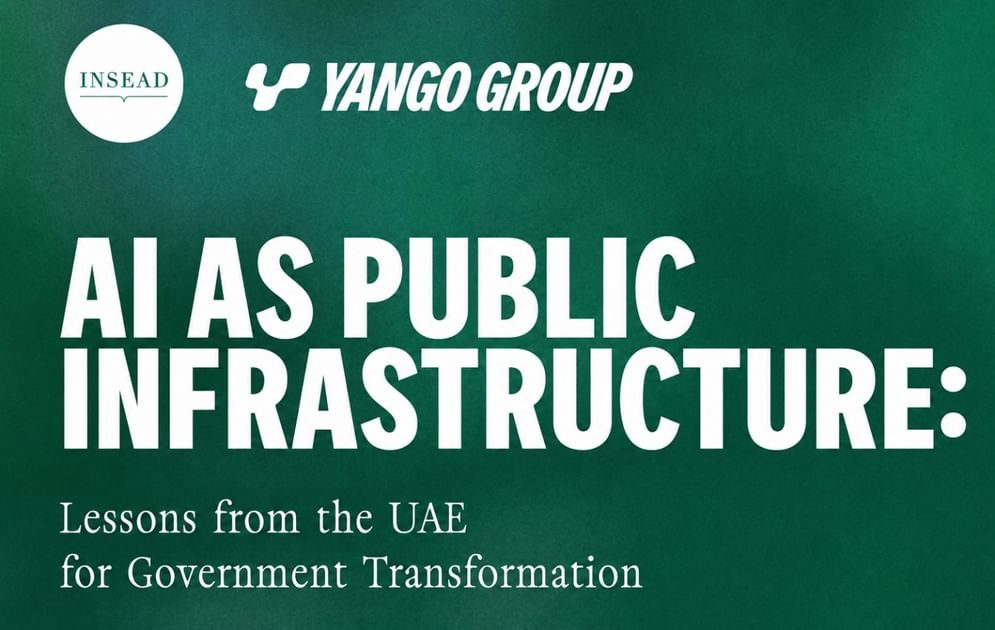
Titled Artificial Intelligence as Public Infrastructure: Lessons from the UAE for Government Transformation, the study concludes that AI has entered a new phase within government institutions. The primary challenge is no longer whether the technology can be adopted, but how it can be designed, governed, and institutionally embedded to deliver long-term public value.
According to the report, many governments around the world continue to face obstacles in moving beyond pilot projects. Common challenges include fragmented responsibilities across agencies, difficulties in scaling successful initiatives, and the absence of clear governance frameworks for managing AI systems.
The study identifies three key institutional factors underpinning the UAE’s progress: sustained and long-term leadership commitment, the redesign of government processes across sectors, and the strategic use of procurement and partnerships as transformation tools rather than purely administrative functions.
Several UAE initiatives are highlighted as practical examples of this approach. These include the UAE National Strategy for Artificial Intelligence 2031, which serves as a national framework for institutional coordination, and the Abu Dhabi Government’s TAMM platform, which has evolved into an AI-enabled government ecosystem offering more than 1,000 public services.
The report also examines Dubai’s AI adoption acceleration initiative, which successfully narrowed 183 proposed use cases to 15 high-impact applications spanning mobility, healthcare, logistics, and urban infrastructure. These projects were selected based on their ability to generate measurable value and support broader government transformation objectives.
In Abu Dhabi, the study points to a strategy centred on prioritising digital infrastructure, supported by sovereign cloud capabilities and an ambitious vision to establish an AI-powered government model. This foundation, the report argues, enables the effective deployment of AI solutions across government entities while maintaining control over critical data and services.
The research was based on a systematic review of international experiences across the United Kingdom, Singapore, the United States, the European Union, and China. The findings suggest that governments with access to similar technological tools often achieve significantly different outcomes depending on governance structures, procurement practices, implementation models, and performance evaluation mechanisms.
The report further notes that implementation challenges are often less related to the capabilities of AI models themselves and more closely linked to fragmented data systems, shortages of professionals who combine technical expertise with policymaking knowledge, and governance frameworks struggling to keep pace with rapid technological deployment.
The research was led by Peter Zemsky and drew on interviews with government officials and artificial intelligence experts from across the UAE. Contributors included representatives from Dubai Future Foundation, Abu Dhabi Government Enablement Department, Mubadala, Core42, and Inception.
Yango Group, which deploys AI technologies across mobility, logistics, mapping, and digital platform services in multiple international markets, contributed operational insights on AI governance and the challenges of scaling intelligent systems within complex operating environments.
Commenting on the findings, Islam Abdel Karim said the debate has shifted from whether governments should adopt AI to how they can build the institutional frameworks, operational structures, and infrastructure required to support large-scale deployment. He noted that the UAE’s experience demonstrates how artificial intelligence is increasingly becoming an integral component of long-term government and operational systems.
For his part, Mark Mortensen said AI is often viewed primarily as a technological transformation, whereas the study shows that scaling it successfully is equally an institutional challenge. By approaching AI as public infrastructure, he added, the UAE offers a practical model and valuable lessons for governments seeking to translate AI ambitions into sustainable public value.