

Institutional adaptability remains one of the most critical determinants of military effectiveness in dynamic strategic environments. Armed forces that adhere rigidly to organisational structures designed for past operational contexts often struggle to meet the demands of contemporary warfare. A prominent example of successful institutional adaptation is the restructuring of the United States Army in the early twenty-first century, when it transitioned from a division-centric force structure to a brigade-centric model. This transformation emerged in the aftermath of combat operations in Afghanistan and Iraq, where operational experience highlighted the need for more flexible and rapidly deployable formations. The shift reflected the concept of strategic alignment, whereby military structures and capabilities are adjusted to match the realities of the operational environment and the requirements of national defence strategy.
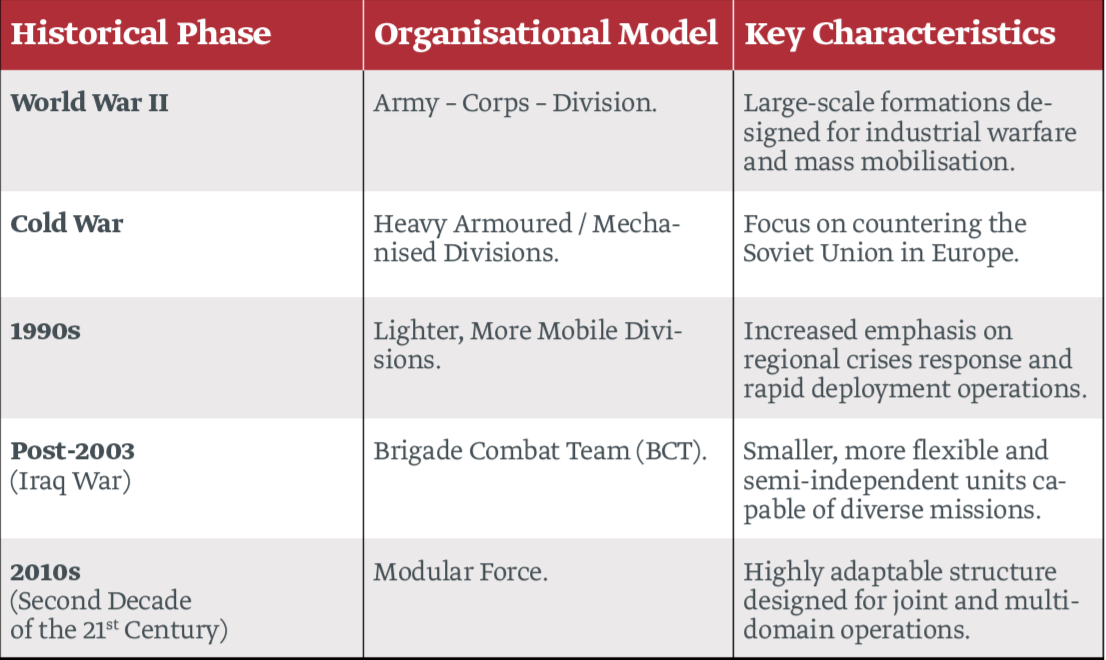
Evolution of U.S. Army Force Structure
This transformation came in the aftermath of combat operations in Afghanistan and Iraq, where operational experience revealed the need for more flexible and rapidly deployable formations. This shift reflected what is known in the literature of strategic leadership as strategic alignment—that is, aligning organisational structure and military capabilities with the nature of the operational environment and the requirements of military strategy.
The Traditional Structure: A Division-Centric Army
Throughout the second half of the twentieth century, the U.S. Army relied on a division-based organisational model, with the division serving as the principal unit of operations. Typically, a division comprised several brigades alongside a wide range of support units, including artillery, reconnaissance, engineering, and sustainment elements. This structure was shaped by the strategic context of the Cold War, during which military planning focused on the possibility of large-scale conventional warfare, particularly in the European theatre. Such a model proved highly effective in what is often described as “industrial warfare,” characterised by the large-scale mobilisation of manpower, economic resources, and industrial capacity.
However, the post-Cold War security environment introduced new operational challenges. The rise of limited conflicts, counterinsurgency operations, and the frequent deployment of forces across multiple regions exposed the limitations of a structure built around large, heavy formations. As a result, the division-centric model became increasingly misaligned with the demands of modern operations.
The Evolution of the Operational Environment
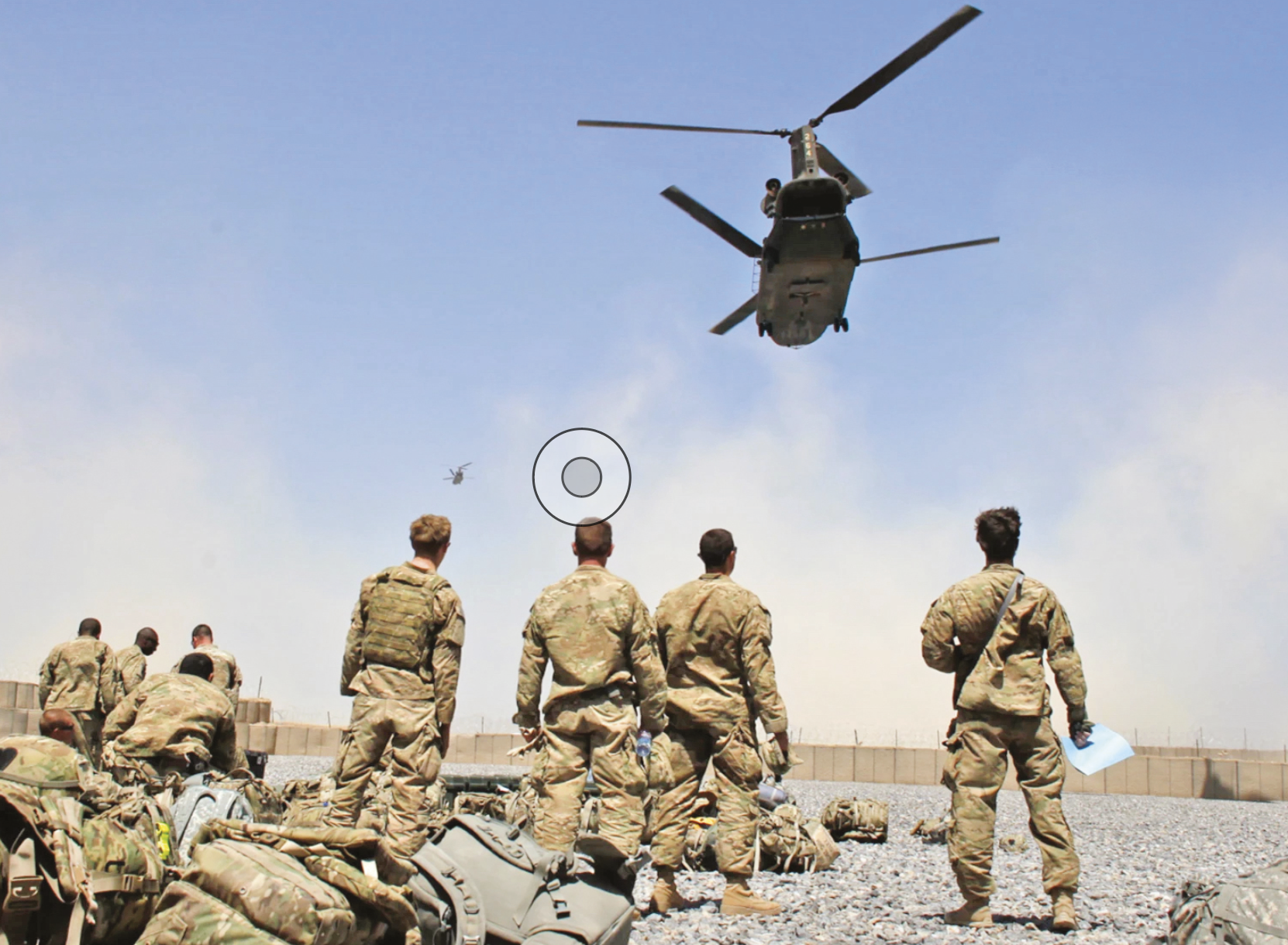
The military campaigns in Afghanistan (2001) and Iraq (2003) underscored the changing nature of warfare. Unlike the conventional scenarios envisioned during the Cold War, these conflicts required forces to operate across vast and dispersed geographic areas, often deploying smaller units to multiple locations simultaneously.
Operational demands became more diverse, ranging from high-intensity combat to counterinsurgency, stabilisation efforts, and peacebuilding missions. Moreover, these operations were frequently conducted within joint and multinational frameworks, requiring enhanced coordination, rapid decision-making, and organisational flexibility.
Early indications of this shift had already appeared during NATO operations in the Balkans in the 1990s, but it was in Afghanistan and Iraq that the need for transformation became unmistakable. The existing force structure revealed a growing gap between organisational design and operational reality, prompting a reassessment of how land forces should be structured.
In response, the need emerged for smaller, more agile formations with greater operational independence. These units had to be capable of repeated deployments, adaptable to diverse mission sets, and easily integrated into joint and multinational operations. Enhancing command and control effectiveness, improving force distribution across theatres, and adapting to unconventional warfare became central priorities.
Transition to a Brigade-Centric Model
Within this context, the U.S. Army’s organisational transformation can be understood as a practical application of strategic alignment. While division-based formations retained their relevance in large-scale conventional warfare, they proved less effective in environments requiring rapid deployment and high organisational flexibility. To address these challenges, the Army adopted a comprehensive restructuring programme in the early 2000s known as the Army Modularity Initiative. At the core of this initiative was the establishment of the Brigade Combat Team (BCT) as the primary deployable combat unit. Under this model, brigades were redesigned as modular, standardised formations capable of operating independently or as part of larger force structures.
This shift significantly enhanced the flexibility and responsiveness of land forces. It enabled operational commanders to tailor force composition according to mission requirements and operational conditions, thereby improving overall effectiveness.
The objectives of this transformation included:
• Enhancing rapid deployability
• Increasing operational flexibility
• Improving command and control effectiveness
• Strengthening adaptability to unconventional warfare
• Expanding the operational independence of formations
• Facilitating integration into joint and multinational operations
Structure and Capabilities of Brigade Combat Teams
Under the new structure, Brigade Combat Teams were designed to possess a high degree of self-sufficiency. Each BCT integrates key combat and support capabilities within a single formation, enabling it to conduct operations with minimal reliance on higher-level units.
A typical BCT includes infantry or armoured units, an artillery battalion, reconnaissance and surveillance elements, combat engineering units, and dedicated logistical support components. These elements are permanently assigned to the brigade, along with advanced command and control systems.
As a result, brigades evolved from subordinate elements within divisions into relatively autonomous formations capable of independent deployment or integration into larger operational frameworks, depending on mission requirements.

Strategic Alignment Between Structure and Operational Environment
The U.S. Army’s restructuring experience represents a practical application of the concept of strategic alignment in military leadership. Strategic leadership extends beyond the formulation of vision and doctrine; it also encompasses ensuring coherence among all elements of the military institution—including organisational structures, capabilities, and resources—in line with the demands of the operational environment.
In the case of the U.S. Army, military leadership recognised that the evolving operational landscape required a force that was more agile and rapidly deployable. This realisation necessitated a fundamental adjustment in force structure to reflect these emerging requirements. The restructuring effort was therefore not an isolated organisational reform, but part of a broader process aimed at adapting the military institution to the realities of contemporary conflict.
Key Lessons Learned
The transition to a brigade-centric model offers several important lessons for modern military institutions. Foremost among these is the need to avoid organisational rigidity. Military structures must remain subject to periodic reassessment in response to evolving strategic environments and shifting threat landscapes. The U.S. experience demonstrates that adherence to legacy force structures can constrain operational effectiveness, whereas institutional adaptability preserves relevance and responsiveness.
Equally significant is the importance of aligning force design with the actual requirements of the operational environment, rather than relying solely on traditional frameworks or institutional legacy. Operations in Afghanistan and Iraq illustrated that structures optimised for large-scale conventional warfare are not necessarily suited to repeated deployments or to complex missions that combine conventional combat, stabilisation, and counterinsurgency tasks.
The experience also highlights the decisive role of strategic leadership in identifying gaps between organisational design and operational reality, and in taking the necessary institutional decisions to bridge those gaps. The transformation of the U.S. Army was not merely a limited structural adjustment, but a comprehensive effort to realign the force with new operational demands.
Furthermore, the case underscores the importance of organisational flexibility as a core element of military power in contemporary conflicts. Forces composed of adaptable, rapidly deployable formations are better positioned to respond to a wide range of missions and scenarios, thereby enhancing operational effectiveness and expanding the options available to military commanders.
Toward a Modular Force
The evolution of U.S. Army force structure did not end with the adoption of the Brigade Combat Team model. It continued toward a broader conceptual development known as the Modular Force. This concept is based on organising land forces into standardised, modular units that can be reconfigured and combined flexibly according to mission requirements and operational conditions.
Rather than relying on fixed, large formations, the modular approach enables the construction of tailored operational groupings from a pool of specialised units. This provides greater adaptability, particularly in joint and multi-domain operations, where forces must operate seamlessly across land, air, maritime, space, and cyber domains. This trend has become increasingly relevant in light of the evolving character of warfare, which is marked by the integration of multiple operational domains and the growing complexity of conflict environments. Flexible organisational structures are therefore essential to ensure effective participation in multi-domain operations and to maintain operational superiority.
Conclusion
The restructuring of the U.S. Army underscores that military superiority in the modern era is not determined solely by technological advancement or force size. Equally important is the degree to which military organisation aligns with the nature of anticipated operations.
In a strategic environment characterised by complexity and uncertainty, the ability to achieve strategic alignment between vision, structure, and the operational environment emerges as a decisive factor in the success of military institutions.●
By: Major General (Ret.) Khaled Ali Al-Sumaiti