


The recently developed National Agricultural Security Action Plan under the administration of US President Donald Trump identifies American farmland, laboratories, and supply chains as among the country’s key national security assets. This marks a significant shift in the United States’ approach to agriculture and is consistent with assessments that agriculture has become a major instrument of modern warfare, as well as a critical factor in the ongoing US-China strategic competition.
Agriculture has long played a pivotal role in determining the course of wars, at times proving more decisive than weapons and military tactics. As the primary source of food, agriculture has strategic importance during wartime. One of the most prominent ways in which agriculture and food have been used in warfare is through the destruction of crops and food stores to disrupt an adversary’s supply lines. Historical accounts document the burning of grain fields by the ancient Greeks during their wars. The Romans similarly employed what became known as systematic plundering, involving the seizure and destruction of crops and livestock belonging to their enemies. This approach also prevailed in Europe during the Middle Ages, when the English used it extensively against France during the Hundred Years’ War. During the American Indian Wars, numerous accounts indicate that General Philip Henry Sheridan employed scorched-earth tactics against Native American populations, including the destruction of crops and livestock. Agricultural resources and grain stores were also extensively targeted during the American Civil War, particularly by General William Sherman, whose forces destroyed crops, corn stores and silos during their advance through Georgia.
Germany, meanwhile, targeted Allied horses with anthrax and glanders in an effort to undermine the Allies’ ability to transport food and agricultural supplies. During the First World War, more than 450,000 Germans are estimated to have died as a result of shortages of agricultural products and food caused by the Allied blockade of food and fertilisers. Against this backdrop, some assessments have concluded that one of the most effective ways to defeat an adversary is through control of food supplies and agricultural production.
During the Second World War, Britain introduced strict agricultural policies aimed at protecting the production of essential supplies needed to support the war effort. The British government regarded agriculture as a reserve occupation and established programmes to release military personnel with agricultural expertise from service, allowing them to contribute to the production needed to feed and clothe both civilians and military personnel during the war.
Germany, by contrast, sought to restrict the flow of food to Britain, although these efforts ultimately failed. The Nazis also pursued a strategy of starving the Soviet population during the Siege of Leningrad. During the Cold War, agriculture continued to serve as a key instrument in the confrontation between the United States and the Soviet Union. This was particularly evident in the emergence of “grain diplomacy”. During the 1970s, the Soviet Union became heavily dependent on US grain supplies to compensate for shortfalls in domestic agricultural production, before Washington imposed a grain embargo following the Soviet invasion of Afghanistan.
How Agriculture Became a Key Instrument of Modern Warfare
Following the end of the Cold War and the beginning of the new millennium, agriculture and food became increasingly important instruments in wars and conflicts. Agricultural systems could no longer remain neutral in these conflicts; instead, they became key tools employed as part of broader strategies of control. The use of food and agriculture as weapons in armed conflicts is prohibited under international law. The right to food is recognised under the International Covenant on Economic, Social and Cultural Rights of 1966. The 1977 Additional Protocols to the Geneva Conventions also prohibit attacking, destroying or removing objects indispensable to the survival of civilians, including foodstuffs, agricultural areas and crops. This principle was further reaffirmed in the Rome Statute of the International Criminal Court in 1998. In 2018, the UN Security Council adopted Resolution 2417, which recognised the starvation of civilians as a war crime.
Despite these legal prohibitions, recent conflicts have demonstrated that agriculture continues to be weaponised through a variety of methods. One such method involves manipulating access to food aid, as illustrated by the war in Ethiopia’s Tigray region, where Western reports indicated that Ethiopian and Eritrean forces obstructed the delivery of humanitarian assistance to parts of Tigray in 2021.
A second method involves exploiting food insecurity to attract and recruit individuals. Some terrorist groups have adopted this strategy by targeting agricultural infrastructure and using access to food as a means of attracting and recruiting fighters.

A third and more widespread method is the targeting of agricultural infrastructure itself.
Recent examples of the weaponisation of food and agriculture, including the Russia-Ukraine war and the civil war in Sudan, have revealed a new dimension: the transformation of agriculture and food into long-range strategic weapons capable of generating effects well beyond the immediate geographical boundaries of the conflict.
The war in Ukraine, for example, demonstrated how agricultural resources can be used as instruments of influence and to secure international support from countries that depend on Russian food imports.
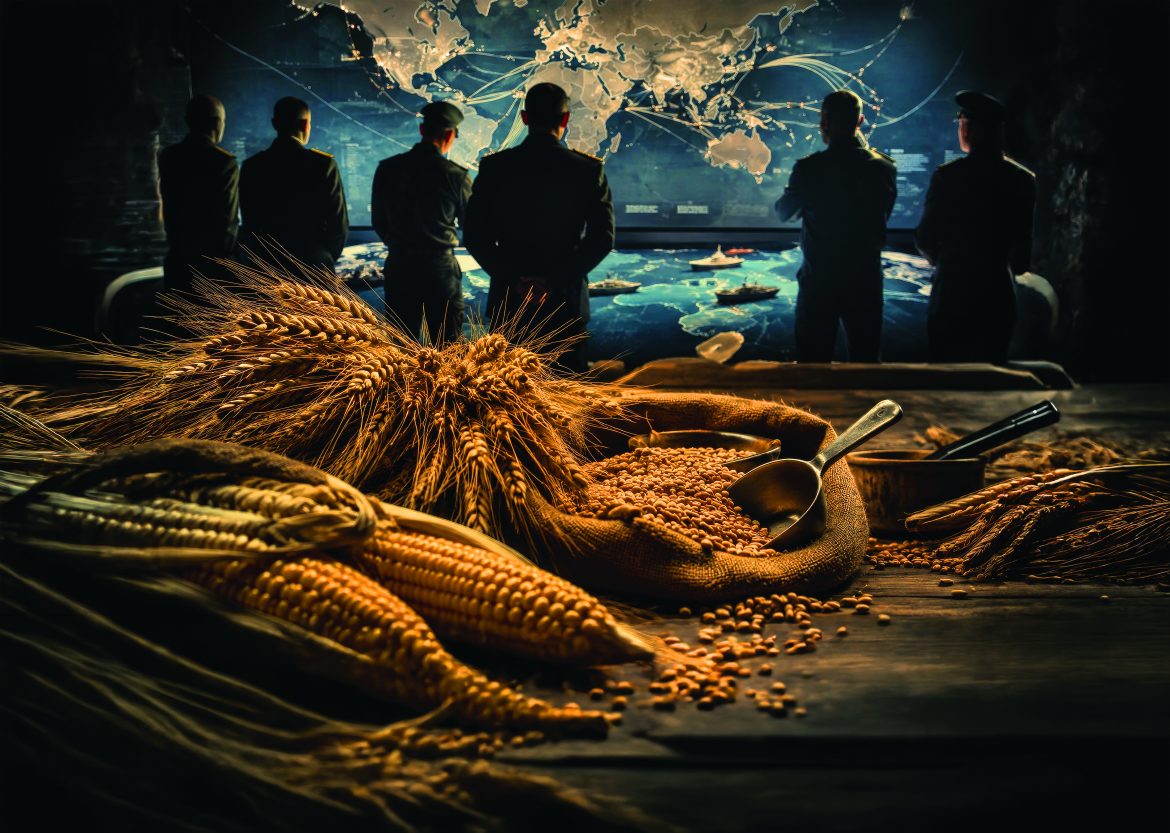
In September 2025, retired US Army Colonel and former US Department of Agriculture official Chris Young presented an assessment before the US House of Representatives Homeland Security Subcommittee during a hearing on the threat of agroterrorism and Washington’s preparedness to address it. He warned that if the United States enters a future war with its adversaries, food will be as important as conventional military capabilities such as missiles or submarines.
The hearing followed reports of China’s growing influence over US agriculture, with Beijing gaining financial interests in American farmland and raising important questions about the long-term security of the US food supply. In the seeds and agricultural chemicals sector, for example, four major companies dominate the global market: one American company, two German companies, and the fourth, Syngenta Group, is owned by China’s ChemChina. Beijing also currently controls around 90 per cent of global supplies of amino acids and vitamins used in livestock feed, on which cattle and poultry producers in some US states, including Missouri and Illinois, depend. In addition, China controls critical links in the US food supply chain, as reflected in the acquisition of Smithfield Foods, one of the largest pork producers and processors in the United States, by the Chinese WH Group.
The most serious concern for US food security, however, is China’s growing acquisition of American agricultural land. By 2023, Chinese companies had acquired more than 275,000 acres of US farmland, compared with relatively limited holdings a decade earlier. Although this represents a small share of total US agricultural land, the concern is not limited to the size of these holdings. It also stems from their strategic locations, with many Chinese-controlled properties situated near energy facilities, export ports, railway stations and other strategically important sites.
In this context, a report by the US-based Heritage Foundation noted that although farmland owned by Chinese entities still accounts for only a limited proportion of total US agricultural land, such holdings have grown steadily in recent years. This has occurred alongside a more than tenfold increase in Chinese overseas agricultural investment between 2009 and 2016. Between 2011 and 2020, China gained control of more than 6.48 million hectares, or approximately 16 million acres, of agricultural land worldwide, compared with around 860,000 hectares controlled by US companies and approximately 1.56 million hectares held by British companies. The report stressed the need to treat this development as a major threat amid the ongoing new Cold War between Washington and Beijing.
The Nature and Evolution of Agroterrorism
A report by the US RAND Corporation defines agroterrorism as the deliberate introduction of a disease-causing agent into food supply chains or livestock with the aim of undermining social and economic stability. The concept differs from “agricultural crime”, which refers to illegal activities affecting the agricultural sector, including the manipulation of agricultural products, pesticide fraud and the destruction of agricultural resources.
Agroterrorism, by contrast, involves the use of biological weapons or deliberate attacks against crops or livestock with the objective of creating disorder or threatening food security. Such acts are often driven by political or social objectives and can also serve as a key instrument of warfare.
As a form of bioterrorism, agroterrorism poses significant risks to human populations by targeting agriculture with harmful bacteria or viruses, potentially destroying or severely damaging agricultural production. The threat is further compounded by the vulnerability and accessibility of agricultural sites, which can make them relatively easy targets.
The phenomenon is not new. History contains numerous examples of the use of lethal biological agents against an adversary’s crops during wartime. Since the 1920s, Britain, France, Germany and Japan have conducted research into biological weapons capable of targeting agricultural crops, focusing on diseases such as potato late blight, rice blast and wheat rust.
During the Second World War, Germany attempted to target British potato crops by using Colorado potato beetles. Japan similarly investigated the effects of fungi, bacteria and nematodes on various agricultural crops and began stockpiling grain-rust spores with the intention of attacking US and Soviet wheat fields if the war continued.
The United States, meanwhile, began testing various crop pathogens in 1944 with the aim of targeting wheat in Ukraine and Chinese rice fields during the Cold War. Between 1951 and 1969, Washington stockpiled more than 30 tonnes of spores of the fungus responsible for wheat stem rust.
Agroterrorism activities continued during the 1970s and 1980s. Notable examples included the cyanide poisoning of Sri Lankan tea leaves in 1985 and the contamination of grapes in Chile in 1989. The Mau Mau movement, which emerged in Kenya during the 1950s and 1960s, also used such methods to poison British livestock. During the Iran-Iraq War in the 1980s, Baghdad developed wheat bunt as a means of targeting Iranian crops.
In recent years, however, agroterrorism has undergone significant changes, most notably through the expansion of its potential scope as major powers develop increasingly sophisticated means of targeting adversaries. Such capabilities could generate widespread disruptions and far-reaching consequences.
In this context, the US government charged three Chinese researchers from a University of Michigan laboratory in November 2025 with conspiring to smuggle biological materials into the United States, arguing that the materials posed a threat to US agricultural and food security. In June 2025, US Attorney General Jerome Gorgon charged Chinese nationals with smuggling Fusarium graminearum into the United States. Washington classifies the fungus as a potential agroterrorism weapon because it causes head blight, a disease affecting wheat, maize, barley and rice and resulting in substantial annual losses.
As the agricultural sector becomes increasingly dependent on cyber systems and the Internet of Things to operate equipment and logistical services and manage supply chains, attacks against these systems could cause severe damage to agricultural production and, consequently, disrupt food supplies.
Agroterrorism can therefore undermine the integrity and security of agricultural and food systems by directly disrupting food supplies through biological, chemical or radiological agents. Such attacks can generate wide-ranging economic and social consequences, making the protection of agricultural infrastructure and food supply chains an increasingly important component of national security.
Trump’s Agricultural Security Plan
For decades, the United States treated agriculture largely as a “support portfolio”, which at times intersected with national security policies. This perspective, however, appears to have changed significantly in recent years, as the administration of US President Donald Trump launched a comprehensive government strategy that views farmland, laboratories and US supply chains as national security assets rather than merely inputs into commodity markets.
In July 2025, US Secretary of Agriculture Brooke Rollins announced the “Make Agriculture Great Again: National Farm Security Action Plan”, which seeks to integrate agriculture as a core component of national security and address external threats to this vital sector. Notably, the initiative was announced in the presence of US Secretary of Defence Pete Hegseth, Secretary of Homeland Security Kristi Noem and Attorney General Pam Bondi. Their participation reflects the importance agriculture is expected to assume in any future US conflicts. Consistent with this emerging US approach, a memorandum of understanding was signed in February 2026 to establish closer links between the US Department of Agriculture and the Defense Advanced Research Projects Agency (DARPA), with the aim of strengthening agricultural security and defence.
These developments are consistent with reports warning that agriculture could become a key instrument in the emerging new Cold War between the United States and China. One example is the Heritage Foundation publication “Winning the New Cold War: A Plan for Countering China”, which recommended including the US Department of Agriculture in the Committee on Foreign Investment in the United States (CFIUS) when reviewing agricultural land acquisitions by Washington’s adversaries. It also called for identifying the locations of critical infrastructure that could potentially be affected by agricultural land purchases.
China, meanwhile, adopted a comprehensive Food Security Law in December 2023, strengthening state control over agricultural land and establishing food self-sufficiency as a national security obligation. Within this framework, Beijing has also expanded its holdings of agricultural land overseas.
The Future Role of Agriculture in Modern Warfare
Several US reports have indicated that agriculture-including farmland, laboratories, genetic stockpiles and associated data-could become one of the key instruments in any future confrontation between the United States and China. Unlike traditional approaches in which agriculture was employed as a tool and weapon during previous wars, some of the most significant threats facing agriculture and food systems in modern conflicts may involve coordinated and sustained cyberattacks, alongside other forms of targeting and sabotage. Competing states could also employ such tools during peacetime. The United States, for example, has announced the discovery of China-backed hackers who infiltrated US agricultural infrastructure and systems through malicious software. Similarly, some US studies have warned of the potential role Russia could play in targeting American agricultural systems under the Primakov Doctrine, which Moscow embraces and which rejects a unipolar international system dominated by Washington. Targeting the US wheat industry could therefore become one of Moscow’s preferred options in any future confrontation with Washington. The United States is the world’s second-largest grain producer after China, producing approximately 450 million metric tonnes annually. Wheat, however, remains a staple food for Americans, while the United States is also the world’s third-largest wheat exporter.
Any attack on US wheat production could therefore have severe consequences. Although Moscow’s attempts to challenge Washington during the post-Cold War period have not involved direct attacks on American agriculture and food supplies, the experience of the Russia-Ukraine war demonstrates Russia’s willingness to use food as an instrument in future confrontations.
Potential methods could include cyberattacks and attacks on grain storage and transportation infrastructure, restricting fertiliser exports to the US market, or even employing agricultural biological warfare.
Conclusion
Recent developments in the global agricultural sector have demonstrated that agriculture continues to play a decisive role in modern warfare. The use of agriculture and food as weapons has reached a geopolitical level, as demonstrated by the US-China trade war, which has involved agricultural commodities in several respects, as well as continued attacks against agricultural products. The growing weaponisation of agriculture and food has therefore become one of the most prominent instruments of control in modern warfare. Competing global powers are increasingly seeking to develop their capabilities to employ agriculture as an effective instrument in future conflicts.
By: Adnan Moussa (Assistant Lecturer, Faculty of Economics and Political Science, Cairo University)