

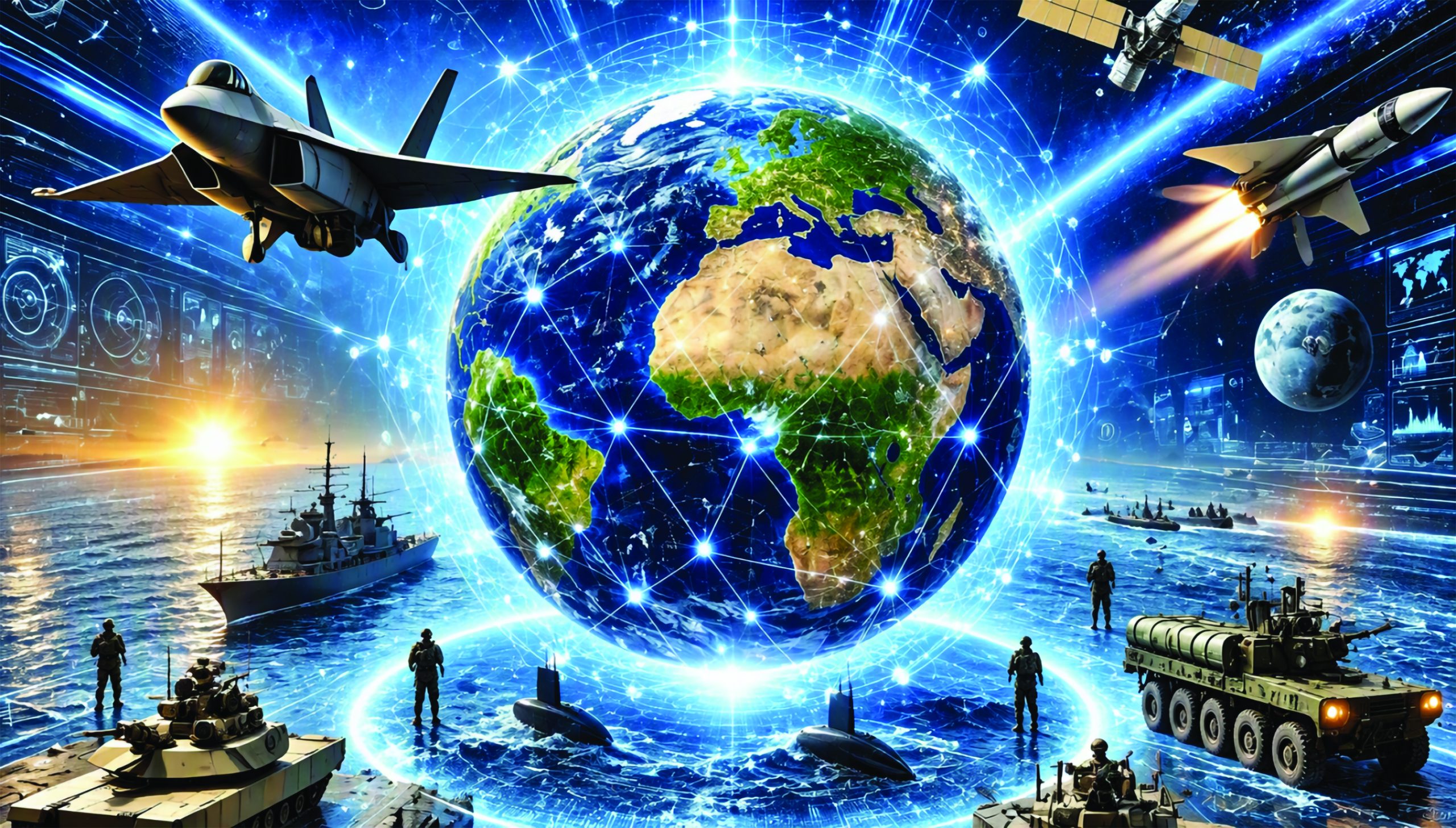
In the contemporary conflict environment, traditional and non-traditional domains are becoming increasingly interconnected, requiring a reassessment of how military capabilities are designed, including the development of human capital and the management of human resources. This is particularly evident in the United States’ experience in identifying what analysts have described as a “Multi-Domain Blind Spot”—an operational gap that can emerge when the required level of integration between the space and cyber domains is not achieved, despite their organisational interconnection within the context of contemporary security challenges.
A study published by the U.S. Army War College’s War Room highlighted that adversaries in the contemporary conflict environment approach the space and cyber domains as interconnected operational domains, while many organisational and planning frameworks—including those in the United States—continue to treat them as institutionally and organisationally separate domains. This disparity creates operational and strategic gaps that adversaries can exploit during the stages preceding conventional military confrontation.
This observation is particularly significant in the context of capability reviews, one of the primary objectives of which is to identify gaps that limit an organisation’s ability to achieve operational integration. Such gaps may be organisational, technological or human in nature, allowing them to be addressed before they develop into vulnerabilities that can be exploited by an adversary.
Hybrid Professionals (T-Shaped Professionals) as a Pillar of Transformation in Capability Review
The study indicates that addressing gaps in a multi-domain operational environment requires a reassessment of how human resources are developed. This aligns with the concept of T-shaped professionals, a term widely used in innovation and Design Thinking to describe individuals who combine deep expertise in a specific field with the ability to integrate and work across other disciplines.
The concept is based on a visual representation of the letter “T”. The vertical line represents deep specialised knowledge and practical expertise in a particular field, while the horizontal line represents the ability to communicate, coordinate, and connect knowledge and efforts across different disciplines. The model does not imply acquiring only superficial knowledge across multiple fields. Rather, it combines deep specialisation with sufficient familiarity with related domains, enabling individuals to work effectively within multidisciplinary teams, translate the requirements of specialists, and build integration between different capabilities to achieve a common operational effect.
This model is particularly important in the multi-domain operational environment examined in the aforementioned study. Analysis indicates that technological superiority in areas such as space or cyber security is insufficient unless it is supported by human expertise capable of connecting these domains and transforming them into an integrated operational capability.
Institutional and cultural separation between specialisations can create what are often described as specialised silos, in which disciplines operate in isolation from one another. This limits the exchange of information and knowledge, undermines operational integration, and slows decision-making during crises. Consequently, hybrid professionals represent one of the key outcomes that modern capability reviews should seek to develop, as they enhance the ability to operate across domains and help close the gaps identified through the review process.
It should be emphasised that capability review cannot be limited to analysing technological or material gaps. It must also examine organisational and cultural factors related to human resources, including institutional workplace culture. This represents a shift from traditional reviews that focus primarily on upgrading systems and restructuring organisations towards comprehensive assessments that link capabilities with human skills and competencies capable of integration.
Capability Review and Human Resource Development: Two Interdependent Tracks
Capability review is a vital tool for understanding the strengths and weaknesses of a national military capability system. It is typically conducted to assess the extent to which military capabilities are suited to strategic missions, analyse and identify gaps in organisational structures, technologies and skills, and determine how investment should be directed to strengthen readiness and deterrence capabilities.
The key lesson from analysing the current situation and anticipating future operations is that individual expertise, regardless of its depth, is insufficient on its own to close emerging gaps in multi-domain conflict environments. There is a growing need for personnel capable of operating across domains as a critical factor in closing the multi-domain gap. As noted above, the value of hybrid professionals lies not only in their specialised knowledge, but also in their ability to connect different domains, translate operational requirements, and generate an integrated effect that extends beyond the boundaries of a narrow specialisation.
The greatest value of hybrid professionals lies in their ability to understand the interdependence between the cyber and space domains as a single system rather than as two separate domains. Cyber operations increasingly depend directly on space-based infrastructure for communications, navigation and data collection, while space systems simultaneously represent sensitive targets and enablers for cyber operations. This integrated understanding makes it possible to recognise the reciprocal effects between the two domains and anticipate the cascading consequences of an attack or disruption in either domain. It also prevents threats from being treated as isolated incidents and helps reduce the perceptual gaps that adversaries may exploit.
Hybrid professionals are also expected to contribute to developing a unified understanding of the operational situation, enabling the effective management of converging threats through their ability to integrate data and indicators from different domains into a single common picture. In an environment characterised by information disruption, multiple data sources and an accelerating operational tempo, bringing together fragmented signals and transforming them into meaningful operational understanding becomes critical.
Cross-domain personnel enable commanders to move beyond partial or fragmented situational awareness and develop a more comprehensive assessment of the operational environment. This supports timely decision-making and reduces the risk of strategic or operational surprise.
At the strategic and operational levels, the importance of such personnel is particularly evident in planning and implementing comprehensive strategies that transcend professional and organisational boundaries. Their role extends beyond coordinating specialists to developing approaches that integrate cyber and space capabilities within a unified course of action to achieve defined political and military objectives.
This represents a shift from Domain Management to Effects Management, in which operations are designed around the desired outcomes rather than institutional or functional boundaries. Hybrid professionals therefore represent a fundamental pillar in developing a genuine multi-domain capability—not merely as an organisational concept, but as an operational practice that can be implemented and sustained.

Practical Recommendations
Based on the above, a number of practical recommendations can be identified to strengthen the methodologies used in comprehensive capability reviews and to develop an effective human-resource base. The inclusion of human-resource analysis within capability reviews should be among the foremost priorities.
First, capability review frameworks should include an explicit assessment of an organisation’s ability to operate across domains. This should include determining whether the workforce possesses the knowledge and skills required to coordinate across different areas of expertise.
Second, organisations should develop cross-disciplinary training programmes. These programmes should provide an integrated understanding of space, cyber operations, intelligence, and operational management and command, rather than relying on isolated training for each specialisation.
Third, organisations could consider establishing dedicated functional cells to facilitate multi-domain integration. These cells would bring together specialists from different domains within joint command-or-control centres, strengthening multi-dimensional thinking in planning and decision-making.
Finally, greater emphasis should be placed on joint training and multi-domain exercises. Practical exercises simulating simultaneous attacks across multiple domains—including land, maritime, air, cyber and space—are essential to strengthening personnel’s ability to respond collectively and make decisions under pressure.
Such an approach helps test the readiness of command-and-control systems, enhance integration between different units and organisations, and improve interoperability. It also supports a seamless transition from planning to execution and enhances operational effectiveness in complex and dynamic threat environments.
Conclusion
In an era in which threats increasingly converge and the boundaries between domains continue to blur, capability review is no longer merely an analytical exercise for assessing and organising capabilities. It has become a multidimensional strategic tool that must also incorporate the organisational human element.
Developing hybrid professionals capable of understanding and integrating different areas of expertise is therefore essential to overcoming gaps in the multi-domain environment and transforming capability review into an effective instrument for addressing contemporary security challenges.
By: Major General (Ret.) Khaled Ali Al-Sumaiti