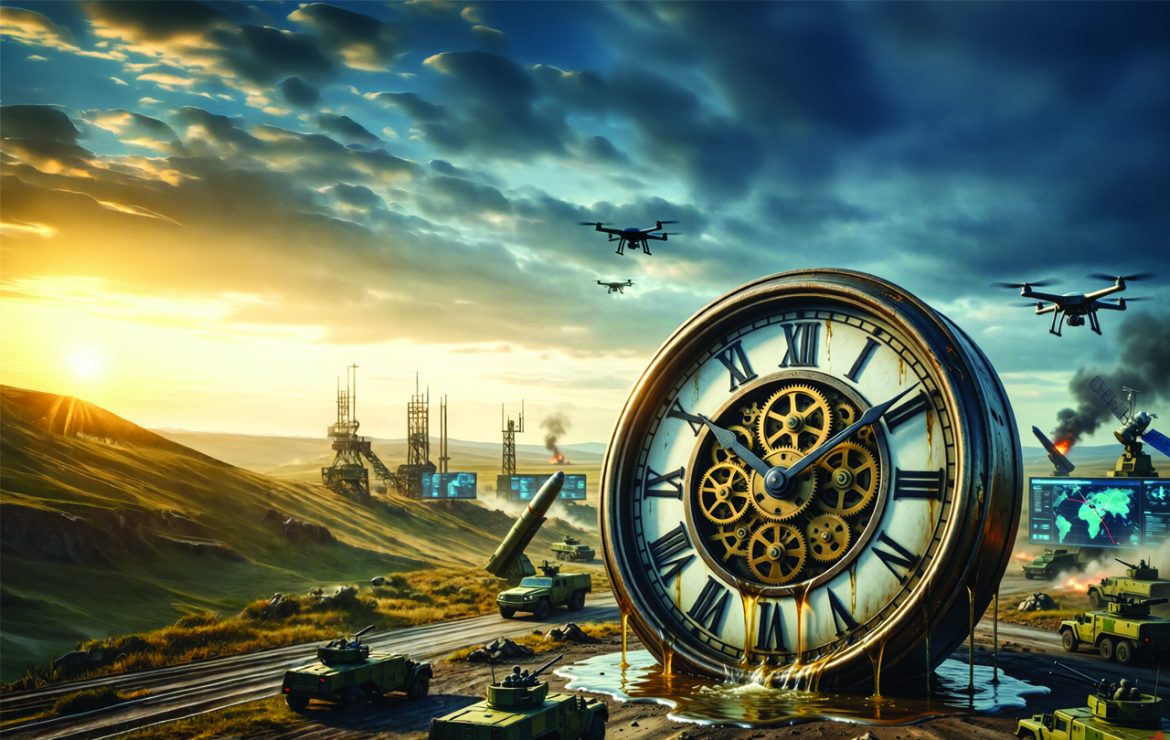


The Russian–Ukrainian war and the Israeli–U.S.–Iranian confrontation demonstrate that the transformation of contemporary warfare extends far beyond advances in weapon systems or the expansion of the battlespace. Increasingly, time itself has emerged as a strategic resource capable of shaping the course and outcome of conflict. In Ukraine, time has been employed as an instrument of attrition, gradually reshaping the balance of power by prolonging the conflict and increasing its cumulative costs. In contrast, the Israeli–U.S.–Iranian confrontation has illustrated the deliberate management of escalation through successive strikes, temporary ceasefires, diplomatic pressure, and carefully calibrated thresholds of confrontation.
Military superiority, therefore, is no longer measured solely by firepower or territorial control. It also depends on the ability to control the rhythm of war—accelerating or slowing its pace, extending or fragmenting its duration, and ultimately shaping the adversary’s political resolve and psychological resilience. This evolution reflects a fundamental shift in the role of time within military thought. In traditional warfare, time was closely associated with the movement of armies, the distances they travelled, seasonal campaigning, and the timing of offensive and defensive operations. During the industrial era, it became linked to national mobilisation, military production, transportation networks, and the management of multiple fronts. In contemporary conflict, however, time has evolved into an independent strategic resource, encompassing the speed of decision-making, operational synchronisation, escalation management, and the ability to regulate the pace of conflict across the military, political, economic, and information domains.
This transformation is increasingly reflected in academic literature. In The Holistic Framework of Time for Warfare, Hiltunen and Huhtinen present a comprehensive understanding of time as a multi-layered phenomenon shaped by biological, psychological, cultural, political, and strategic dimensions. Likewise, Hanska’s Times of War and War over Time argues that operational success depends largely on effective temporal management through the careful selection of decisive moments, the sequencing of actions, and the speed of execution. Emily Eason, in her doctoral thesis Temporalizing the Great War, further contends that war does not merely occur within time but creates its own temporal reality, reshaping perceptions of the past, present, and future while generating distinctive experiences such as waiting, trench time, suspended time, and repetitive time.
 Although these studies have significantly advanced our understanding of time in warfare, they primarily examine time as an operational or contextual variable rather than as a strategic instrument in its own right.
This study therefore seeks to establish the concept of the temporal rhythm of warfare by distinguishing between time in warfare and time as a strategic instrument of warfare. The temporal rhythm of war is not simply concerned with the scheduling of military operations. Rather, it refers to the strategic management of conflict through deliberate control over its speed, duration, intensity, and cycles of escalation and de-escalation. By doing so, time becomes a source of strategic power that can be exploited to exhaust an adversary, disrupt decision-making processes, reshape political and psychological perceptions, and influence both the conditions and outcomes of negotiations. The focus thus shifts from analysing timing to understanding rhythm. While timing concerns the selection of the appropriate moment for action, rhythm encompasses the management of the conflict as a whole, enabling one side to sustain strategic advantage by imposing a temporal framework that its adversary neither controls nor dictates. Building upon this conceptual foundation, the study seeks to make a theoretical contribution by redefining time from a variable that merely explains warfare to a strategic resource that actively shapes and directs it. To achieve this objective, the study pursues three interconnected aims. First, it establishes the temporal rhythm of warfare as a distinct dimension of strategic power. Second, it analyses the evolution of temporal management from the traditional pursuit of rapid military decision towards contemporary approaches based on protraction, fragmentation, acceleration, deceleration, and the calibrated management of escalation. Finally, it tests this theoretical framework through a comparative analysis of the Russian–Ukrainian war and the Israeli–U.S.–Iranian confrontation, highlighting the contrasting ways in which time has been employed in prolonged wars of attrition and in carefully regulated, rhythm-based conflicts.
Managing Time in Contemporary Warfare: From Decisive Victory to Temporal Rhythm
The transition from the traditional pursuit of decisive military victory to the management of temporal rhythm did not emerge suddenly with today’s conflicts. Rather, it reflects the gradual evolution of the relationship between war and time over successive generations of warfare. In traditional warfare, time was primarily associated with the movement of armies, geographical distances, seasonal campaigning, and the conduct of manoeuvre. Managing time meant selecting the most favourable moment for attack, defence, or siege operations. During the industrial age, however, the concept expanded to encompass the speed of national mobilisation, military production, transportation, and the coordination of extended fronts, making the tempo of the state, society, and economy integral components of the tempo of war.
Classical military thought nevertheless continued to regard time principally as a resource that should be compressed. Prolonged wars inevitably consumed greater resources, imposed heavier economic and political costs, and reduced the likelihood of maintaining the strategic initiative. Consequently, military success was historically associated with rapid decision, operational surprise, and the ability to conclude campaigns before an adversary could reorganise its forces or mobilise additional resources. The conflicts that have emerged since the end of the twentieth century—particularly in the wake of the digital revolution and the expansion of warfare across multiple domains—have exposed the limitations of this traditional understanding. Modern wars have become increasingly protracted, interconnected, and multidimensional. Military operations now unfold alongside political competition, economic sanctions, cyber campaigns, information operations, diplomatic pressure, supply-chain resilience, and contests over public perception. Under these conditions, rapid battlefield victory is no longer the sole—or even the primary—determinant of strategic success. Instead, outcomes increasingly depend on a state’s ability to orchestrate these interconnected dimensions over time, transforming time itself into a generator of strategic advantage rather than merely the framework within which military power operates.
As a result, time has evolved from an organisational element of military operations into an independent strategic resource that can be deliberately shaped and exploited in pursuit of political and military objectives. Military decisions no longer possess their own exclusive temporal logic. Political leadership, economic mobilisation, cyber operations, information campaigns, diplomatic initiatives, and societal resilience each operate according to distinct yet interconnected temporal rhythms, the interaction of which directly influences the trajectory and outcome of conflict.
Managing time, therefore, has become inseparable from managing war itself. It is no longer a supporting factor within military operations but a central strategic instrument capable of determining how conflicts unfold, escalate, and ultimately conclude. In this context, the concept of timing alone is no longer sufficient to explain the dynamics of contemporary warfare. Timing merely concerns the selection of the most appropriate moment to initiate or conclude a military operation. Modern conflicts, however, demand a broader concept: the temporal rhythm of warfare. This extends beyond determining when military action occurs to encompass the ability to regulate the speed, duration, intensity, interruptions, and cycles of escalation and de-escalation that define a conflict. In doing so, time itself is reorganised to serve strategic objectives. Strategic initiative is therefore no longer achieved simply by acting at the right moment, but by imposing the temporal framework within which the adversary must operate, compressing the interval between decision and execution while extending the opponent’s decision-making cycle and forcing it to adapt to a rhythm beyond its control. The concept of the temporal rhythm of warfare thus transcends the management of timing within individual military operations and instead addresses the management of time across the conflict as a whole. War is no longer viewed as a sequence of successive battles but as a dynamic process in which time itself is continuously reshaped in pursuit of military and political objectives. Accordingly, strategic effectiveness should not be measured solely by the speed of victory or the length of a conflict, but by the ability to control the conflict’s pace, duration, operational intensity, interruptions, and levels of escalation and de-escalation, thereby imposing a temporal rhythm that the adversary cannot dictate.
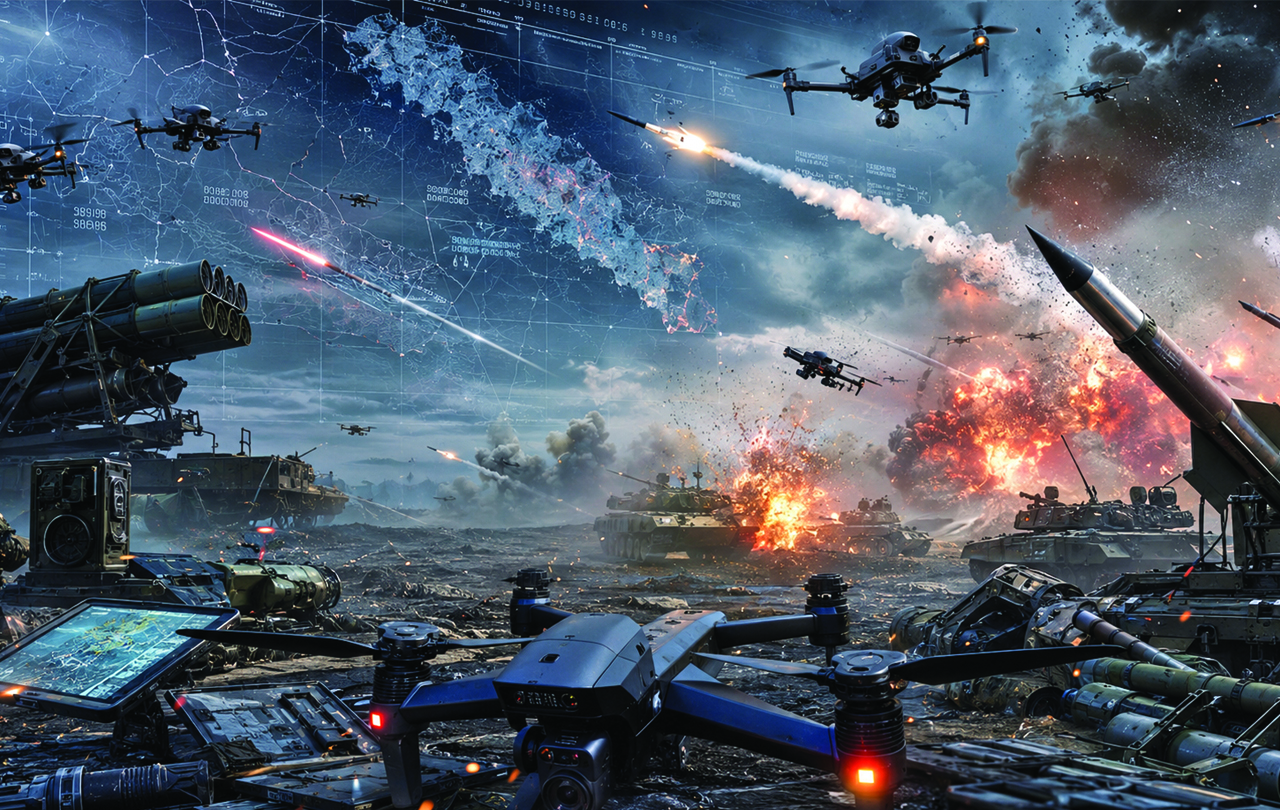 This temporal rhythm is built upon five interrelated mechanisms. These are not sequential stages but flexible instruments that interact according to changing strategic circumstances.
The first is protraction, whereby time is deliberately employed as a tool of attrition to exhaust an adversary’s military capabilities, economic resources, and psychological resilience. In this model, the continuation of war becomes a strategic objective rather than evidence of strategic failure. The second is acceleration, which seeks to intensify military operations and establish political or military faits accomplis before the adversary can adapt or regain the initiative. By compressing the opponent’s response time, acceleration increases operational pressure and limits strategic flexibility.
Conversely, deceleration involves deliberately reducing the tempo of operations to facilitate force repositioning, complete mobilisation, or await strategic developments that may create more favourable conditions. Here, slowing the pace of conflict represents a conscious method of managing power rather than an indication of weakness. The fourth mechanism, fragmentation, manages warfare through successive rounds of military action separated by temporary ceasefires, negotiations, or periods of force regeneration. Under this approach, movement between combat and diplomacy becomes an inherent feature of the conflict rather than a transition from war to peace. Completing this framework is the management of escalation and de-escalation, whereby calibrated levels of violence are employed to strengthen deterrence, improve negotiating positions, or recalibrate the course of the confrontation. Escalation and de-escalation thus become instruments for controlling the rhythm of conflict rather than objectives in themselves. These mechanisms do not function independently. Instead, they interact continuously within the same conflict as military and political objectives evolve. A campaign may begin with acceleration to seize the initiative before shifting towards protraction once rapid victory proves unattainable. It may subsequently adopt a fragmented pattern through ceasefires or negotiation rounds, before returning to escalation or deceleration in response to battlefield developments or international pressure. This constant interaction illustrates that managing time is no longer a linear process but a continuous effort to reshape the temporal rhythm of conflict in accordance with an evolving strategic environment. Consequently, the concept of strategic power itself must be reconsidered. Time has become a strategic resource no less important than the land, maritime, air, cyber, information, or cognitive domains.
The Temporal Rhythm of Warfare Between Attrition and Controlled Escalation: Comparing the Russian–Ukrainian War and the U.S.–Israeli Campaign Against Iran
A comparison of these two conflicts provides an opportunity to test the explanatory value of the temporal rhythm of warfare as a framework for understanding two distinct models of conflict management. The Russian–Ukrainian war represents perhaps the clearest example of a protracted war of attrition, in which time is no longer a factor to be compressed in pursuit of rapid victory but a strategic instrument for gradually reshaping the balance of power. Once the prospect of a swift and decisive outcome faded, the conflict progressively evolved into a strategy centred on prolonging the war itself. Its continuation became a means of eroding the adversary’s military, economic, and human resources, weakening political resolve, and exhausting both domestic capacities and external support. Within this framework, the battlefield has expanded far beyond military operations. Competition now extends into the realms of economic resilience, defence industrial capacity, sanctions, energy security, international assistance, supply chains, and the ability of societies to sustain cohesion over time. Time itself has consequently become one of the principal determinants of strategic power.
By contrast, the U.S.–Israeli campaign against Iran illustrates a fundamentally different approach to temporal management—one that may be described as rhythm-controlled warfare. Here, the primary objective was neither to prolong the conflict nor to secure comprehensive military victory. Rather, the emphasis lay in carefully regulating the level of escalation to prevent the confrontation from expanding into a wider regional war while maintaining sufficient military and political pressure to achieve strategic objectives.
Accordingly, time was not employed to sustain continuous conflict but to regulate its rhythm through limited strikes, calibrated responses, periods of de-escalation, diplomatic initiatives, and negotiating tracks. The movement between escalation and restraint became an integral element of the overall strategy rather than a departure from it. From this perspective, the immediate objective appears not to have been the overthrow of the Iranian regime through military force or the occupation of territory. Instead, the broader aim was to reshape the strategic environment within which the Iranian leadership operates and impose a new set of strategic constraints that would narrow its range of options. Military and political efforts were directed towards addressing the principal drivers of the confrontation, foremost among them Iran’s nuclear programme, its missile capabilities, and its network of regional proxies. At the same time, the campaign sought to encourage a different pattern of Iranian regional behaviour characterised by reduced intervention in regional crises and greater engagement in more stable security arrangements. The objective, therefore, was not necessarily to transform the structure of the Iranian state, but rather to redefine the regime’s strategic function and behaviour in a manner consistent with the new balance of power emerging from the conflict.
This model demonstrates that escalation was not an objective in itself, just as de-escalation did not signify the end of the conflict. Rather, both formed integral components of the temporal management of war. Military strikes were employed to generate cumulative pressure capable of compelling adjustments in strategic behaviour, while periods of de-escalation provided opportunities for force repositioning, the absorption of international political pressure, and the advancement of diplomatic and negotiating tracks without relinquishing deterrence or coercive leverage. Consequently, controlling the tempo of the conflict became more important than maintaining a continuous expansion of military operations. This case therefore offers a clear illustration of the mechanisms of fragmentation and the calibrated management of escalation and de-escalation that underpin the concept of the temporal rhythm of warfare.
The comparison between the two cases reveals that the principal distinction lies not in the level of violence, the scale of military force employed, or the nature of the actors involved, but in the strategic function that time performs within each conflict. In the Russian–Ukrainian war, time serves as a mechanism for gradually reshaping the balance of power through sustained attrition, with each side wagering that the prolonged conflict will exhaust its opponent’s military capabilities, economic resources, political resolve, and psychological resilience before producing the same effect on itself. In contrast, the U.S.–Israeli campaign against Iran employs time as an instrument for regulating escalation and controlling the ceiling of confrontation, enabling specific strategic objectives to be achieved without allowing the conflict to expand into a regional war beyond political and military calculations.
To examine these contrasting approaches, this study adopts four indicators for analysing the temporal rhythm of warfare: duration, tempo, intensity, and the degree of interruption. Together, these variables provide a framework for assessing and comparing patterns of temporal management across the two conflicts.
Applied to the Russian–Ukrainian war, these indicators reveal an extended temporal rhythm characterised by prolonged duration, limited interruptions, and fluctuating operational intensity. The conflict relies heavily on endurance, sustained mobilisation, and continuous defence-industrial production as essential conditions for maintaining the war effort and executing a long-term strategy of attrition. By comparison, the same indicators show that the U.S.–Israeli campaign against Iran follows a shorter, more fragmented, and more variable temporal rhythm. Periods of escalation alternate with phases of de-escalation, limited military strikes, diplomatic initiatives, and negotiation tracks, making interruption an inherent structural feature of conflict management rather than evidence that hostilities have ceased. Similarly, military intensity is not designed to achieve comprehensive battlefield victory but to generate a carefully calibrated level of pressure sufficient to modify the adversary’s behaviour and reshape its strategic calculations. Periods of de-escalation, in turn, provide opportunities to reassess the strategic environment, contain international pressures, and prevent the conflict from widening.
Conclusion
The transformation of contemporary warfare extends well beyond the evolution of weapons, the emergence of new actors, or the expansion of operational domains. More fundamentally, it reflects the redefinition of time as one of the most significant resources of strategic power. Time is no longer a neutral framework within which war unfolds, nor merely a variable measured by the duration of campaigns or the speed of operations. Instead, it has become an independent arena of strategic competition through which military plans are designed and strategies of attrition, escalation, deterrence, coercion, and negotiated pressure are orchestrated to reshape the political resolve and psychological resilience of adversaries. Warfare today is therefore conducted not only through the application of military power in its various forms, but also through the deliberate exploitation of time as a source of strategic advantage. Against this backdrop, understanding contemporary conflict requires more than answering the traditional questions of when wars begin and when they end. It demands a deeper inquiry into how time itself is managed within war and which actor possesses the ability to impose its own temporal rhythm on the adversary. Twenty-first-century warfare is no longer conducted merely within time; it is increasingly conducted through time. The ability to regulate the pace, duration, intensity, interruptions, and cycles of escalation and de-escalation has become one of the principal determinants of strategic effectiveness and a decisive factor shaping both the trajectory and the outcome of conflict. Accordingly, the temporal rhythm of warfare should be recognised as an independent dimension of strategic power, standing alongside military capability, economic strength, technological superiority, and dominance across the land, maritime, air, cyber, information, and cognitive domains. Contemporary conflicts demonstrate that possessing power also means possessing the ability to impose the temporal framework within which an adversary must operate, compelling it to make strategic decisions according to a rhythm it neither chooses nor controls. In this sense, mastery of time has become a distinct form of strategic dominance.●
By: Professor Wael Saleh (Director at TRENDS Research & Advisory – France and Canada)